I'm a participant in the Amazon Services LLC Associates Program, an affiliate advertising program designed to provide a means for me to earn fees by linking to Amazon.com and affiliated sites.
If you’ve ever taken apart a cat water fountain and discovered slimy buildup hiding around the pump, you know that not all fountains are equally easy to maintain.
Some look attractive and advertise elaborate filtration systems, but cleaning them means removing numerous tiny parts, scrubbing narrow tubing, and struggling to reach places where residue accumulates.
That’s one reason stainless steel cat water fountains are appealing.
Unlike many plastic surfaces, stainless steel is nonporous, durable, and generally easier to clean thoroughly. It’s also a good choice for owners who want to minimize worn or scratched plastic surfaces around their cat’s drinking water.
However, a stainless steel fountain isn’t automatically more hygienic if its pump, filters, and hidden compartments are difficult to clean.
For this guide, we focused on three fountains that offer meaningful stainless steel construction, readily available replacement filters, and practical designs for everyday ownership.
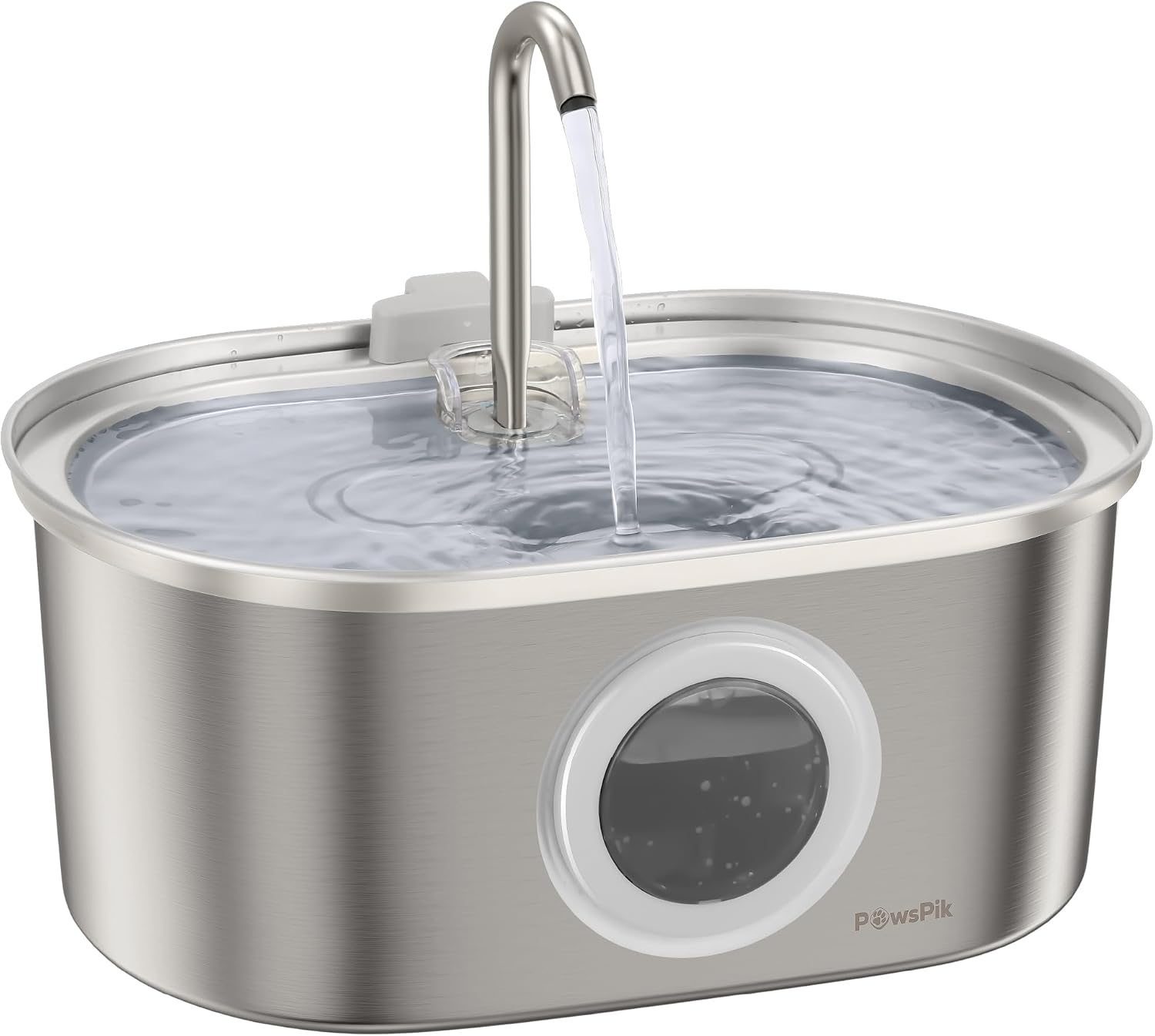
Our top recommendation is the PawsPik SS-01, which offers a large water capacity, two drinking modes, and relatively affordable replacement filters.
The Pioneer Pet Raindrop is our pick for owners who prioritize simple cleaning, while the PetSafe Drinkwell 360 is better suited to households with multiple cats sharing a drinking station.
Here’s how they compare, including the ongoing filter costs that are easy to overlook.
Quick Comparison: Best Stainless Steel Cat Water Fountains
Feature | |||
|---|---|---|---|
 |  |  | |
Best for | Overall value | Easy cleaning | Multiple cats |
Water capacity | 108 oz (3.2 L) | 60 oz (1.8 L) | 128 oz (3.8 L) |
Stainless steel construction | Main drinking and reservoir surfaces | Main bowl and upper housing | Main bowl and housing |
Flow style | Faucet stream or gentle bubble | Flowing stream and pool | Multiple falling streams |
Adjustable flow options | Two modes | No dedicated adjustable-flow setting | Up to five stream configurations |
Filtration | Carbon and sponge filtration | Replaceable charcoal filter | Carbon filter and foam prefilter |
Dishwasher-safe steel components | Yes | Yes | Yes |
Power | Wall outlet | Wall outlet | Wall outlet |
Main drawback | Narrow spout needs careful cleaning | Smaller capacity | More parts to disassemble |
Price |  | | |
All three contain non-stainless-steel components, including pumps, filters, and certain fittings. None should be described as an entirely metal water system.
1. PawsPik SS-01: Best Stainless Steel Cat Water Fountain Overall
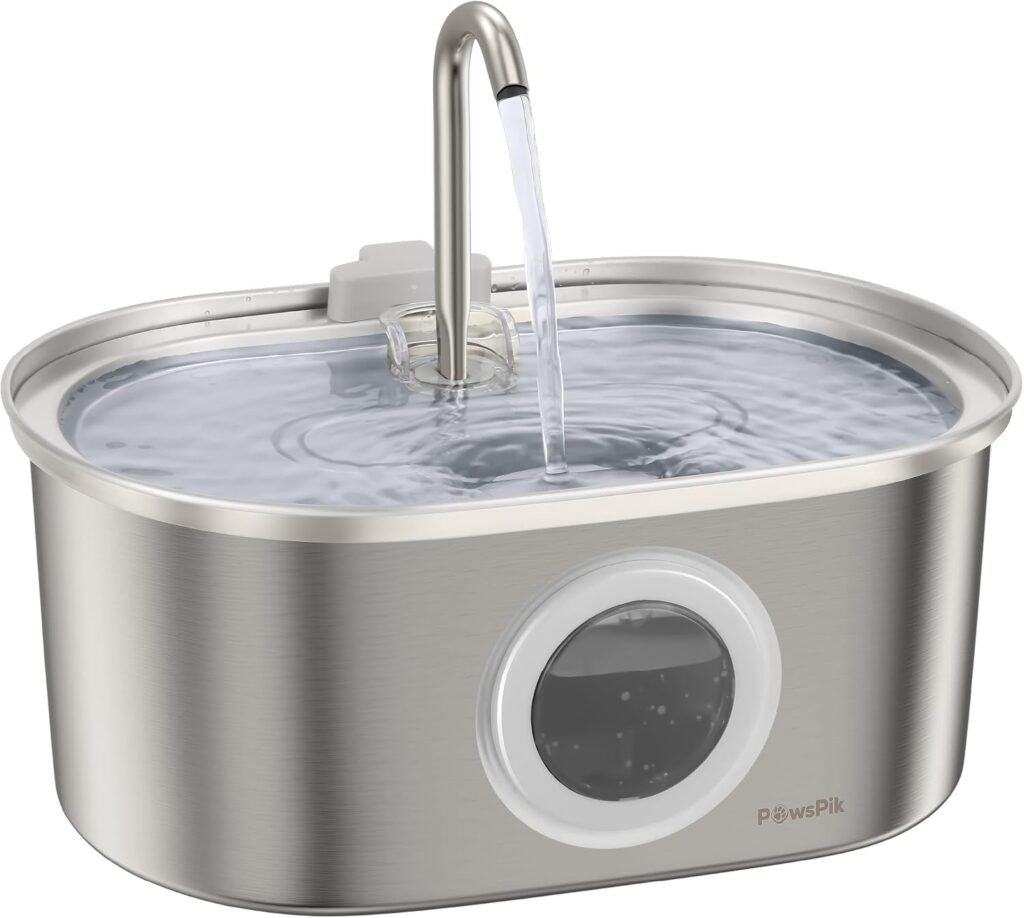
The PawsPik SS-01 is our overall recommendation because it provides several useful features without becoming overly complicated.
It has a generous 3.2-liter water capacity, approximately 108 ounces, and uses 304 stainless steel for its main drinking and water-holding surfaces.
That capacity is larger than many compact cat fountains, making it appealing for owners who want to refill less frequently.
However, capacity alone isn’t the most interesting feature.
The SS-01 also offers two different ways for cats to drink: a flowing faucet-style stream and a gentler bubbling mode.
This is useful because cats don’t all have the same preferences.
Some enjoy drinking directly from running water, while others prefer lapping from a relatively calm surface.
With the PawsPik, you can experiment with both styles without purchasing another fountain.
What makes the SS-01 worth considering?
The stainless steel basin is relatively straightforward to access, and PawsPik describes its stainless components as dishwasher-safe.
A visible water-level indicator also makes it easier to see when the reservoir needs attention without taking apart the fountain.
The manufacturer advertises quiet operation of up to approximately 25 decibels. Actual perceived noise will depend on the room, water level, and how well the pump is maintained.
Its filtration system uses carbon and sponge components to help capture debris and reduce unpleasant tastes and odors.
Those components are replaceable, which is important because filter availability can become a problem with less-established fountain brands.
How easy is it to clean?
The main steel surfaces are fairly accessible, but there’s one part that deserves special attention: the faucet-style spout.
Narrow water passages can collect biofilm even when the surrounding stainless steel remains visibly clean.
Cats.com’s independent testing found that the SS-01’s main components were easy to wash, although cleaning completely through the spout required additional care.
The supplied cleaning brush may not reach the entire passage from one end, so a suitable narrow brush is useful.
The pump also requires periodic disassembly.
Removing visible hair from the intake isn’t sufficient if residue has accumulated around the impeller.
PawsPik recommends cleaning the pump and filter area every two to four weeks. For households with several pets or noticeable buildup, more frequent cleaning may be appropriate.
What do replacement filters cost?
PawsPik sells a pack containing eight replacement filters and sponges.
The manufacturer’s listed replacement schedule is approximately every two to four weeks, depending on water quality and usage.
At a reference price of $17.99 for eight filter sets, that’s roughly $29–$58 annually in replacement filters.
The calculation assumes all eight sets are usable for each scheduled replacement, with no shipping charges or price changes.
That is a relatively manageable ongoing expense for a filtered fountain.
Pros
- Large 108-ounce capacity
- Food-grade stainless steel drinking surfaces
- Faucet and gentle bubbling modes
- Visible water-level indicator
- Accessible main reservoir
- Dishwasher-safe stainless components
- Widely available replacement filter packs
Cons
- Faucet spout requires careful cleaning
- Still contains plastic and electronic components
- Requires an electrical outlet
- Pump must be disassembled periodically
- Water flow may become noisy when the reservoir gets low
Our verdict: The PawsPik SS-01 is the strongest overall choice for owners who want stainless steel construction, a large capacity, and useful drinking options without paying for unnecessary smart features.
It’s especially appealing for cats that enjoy drinking from a sink faucet, although its narrow spout requires more attention during cleaning.
2. Pioneer Pet Raindrop: Best Stainless Steel Fountain for Easy Cleaning
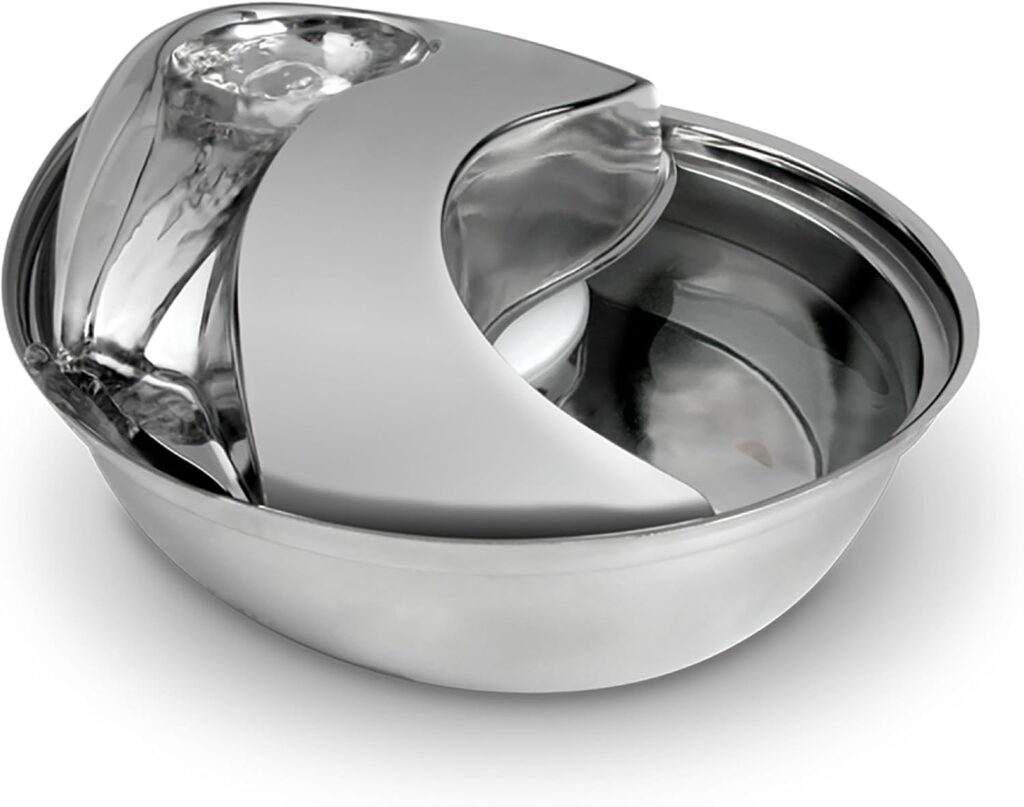
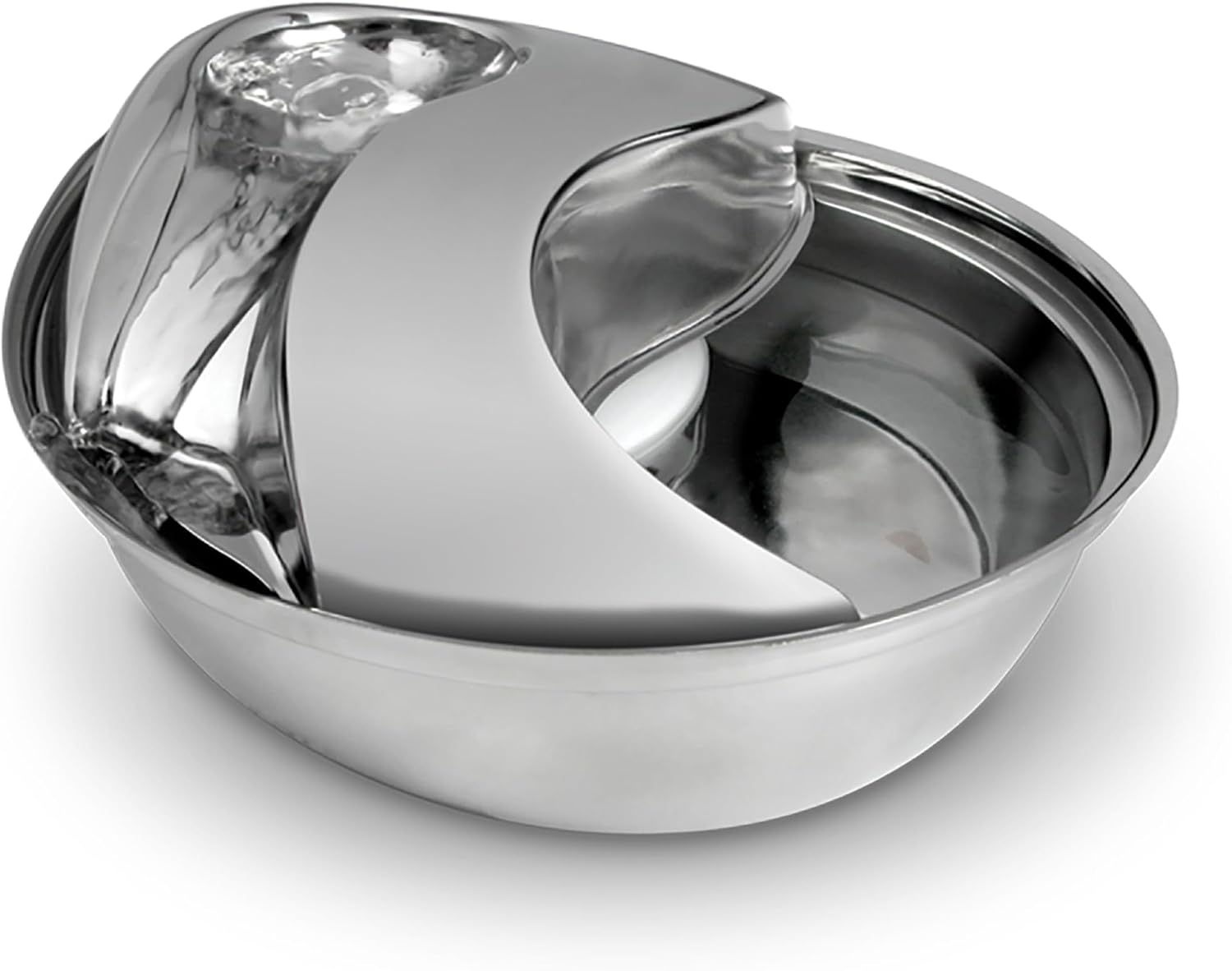
The Pioneer Pet Raindrop is a relatively simple fountain, and that’s a large part of its appeal.
Instead of offering multiple electronic modes or smartphone controls, it uses a stainless steel bowl with a curved upper section that guides circulating water back into the reservoir.
Its distinctive raindrop-shaped design provides a gently flowing stream as well as a small pool from which cats can drink.
The fountain holds approximately 60 ounces of water.
That’s noticeably less than the PawsPik SS-01 or PetSafe Drinkwell 360, but the smaller capacity also helps keep the fountain compact.
For a household with one cat, this may be sufficient, provided the water level is checked and replenished regularly.
Why is the Raindrop easy to clean?
The strongest advantage is its uncomplicated construction.
The stainless steel bowl and upper portion can be removed for washing. Pioneer Pet identifies the stainless steel components as dishwasher-safe.
There aren’t numerous interchangeable water spouts or complicated electronic controls to maintain.
The pump and filter assembly can also be removed, although the pump still needs regular manual cleaning.
Pioneer Pet recommends cleaning the fountain weekly, changing the charcoal filter every two to four weeks, and disassembling the pump for cleaning about once a month.
These are useful maintenance guidelines because they acknowledge that filtration doesn’t replace cleaning.
Is stainless steel better for preventing buildup?
The Raindrop uses 18/8 stainless steel for its primary bowl and housing.
That material is generally resistant to corrosion and easier to clean than scratched or porous surfaces.
However, stainless steel doesn’t prevent every type of buildup.
You may still notice water spots, mineral deposits, and a slippery film forming over time.
Because the Raindrop has a polished metal finish, fingerprints and water marks may actually be more visible than on a plastic fountain.
The benefit is that the main surfaces are accessible for cleaning.
The pump housing and other non-metal components still need attention.
What do replacement filters cost?
Pioneer Pet sells replacement charcoal filters for its ceramic and stainless steel fountains, including the 60-ounce Raindrop.
The manufacturer’s three-pack has a reference price of $10.99.
Replacing one filter every two to four weeks produces an estimated annual cost of approximately $48–$95.
That is higher than the estimated filter cost for the PawsPik SS-01.
However, the Raindrop’s simpler design may appeal to owners who value straightforward maintenance more than having the lowest possible consumable expense.
Pioneer Pet also sells replacement pumps, which is useful if the motor eventually fails.
Pros
- Simple, accessible stainless steel construction
- Dishwasher-safe metal components
- Compact footprint
- Two drinking areas
- Replaceable pump and charcoal filter
- No Wi-Fi, app, or unnecessary electronics
- Low-profile drinking area
Cons
- Smaller 60-ounce water capacity
- No dedicated adjustable-flow control
- Shows water spots and fingerprints
- Requires more frequent refilling in multi-pet homes
- Relatively expensive replacement filters over time
Our verdict: Choose the Pioneer Pet Raindrop if your priority is a straightforward fountain that you can take apart, wash, and reassemble without dealing with unnecessary features.
Its smaller reservoir makes it best suited to single-cat households or owners who don’t mind checking and refreshing the water frequently.
3. PetSafe Drinkwell 360: Best Stainless Steel Water Fountain for Multiple Cats
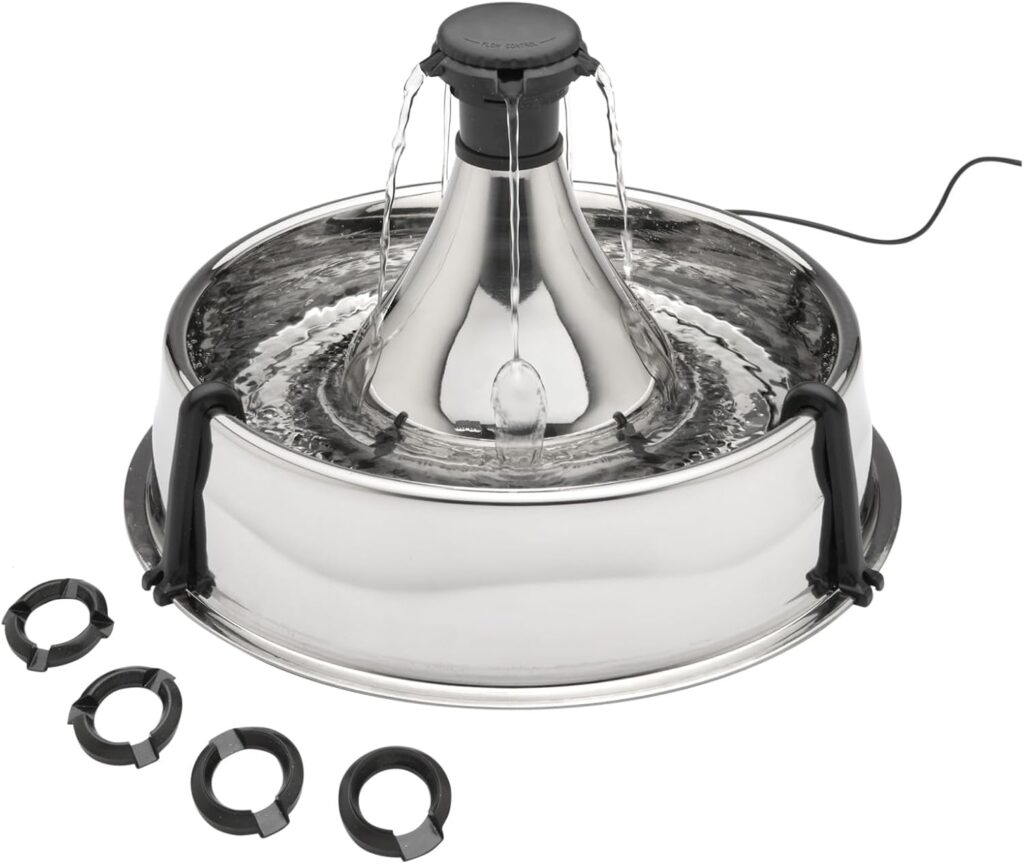
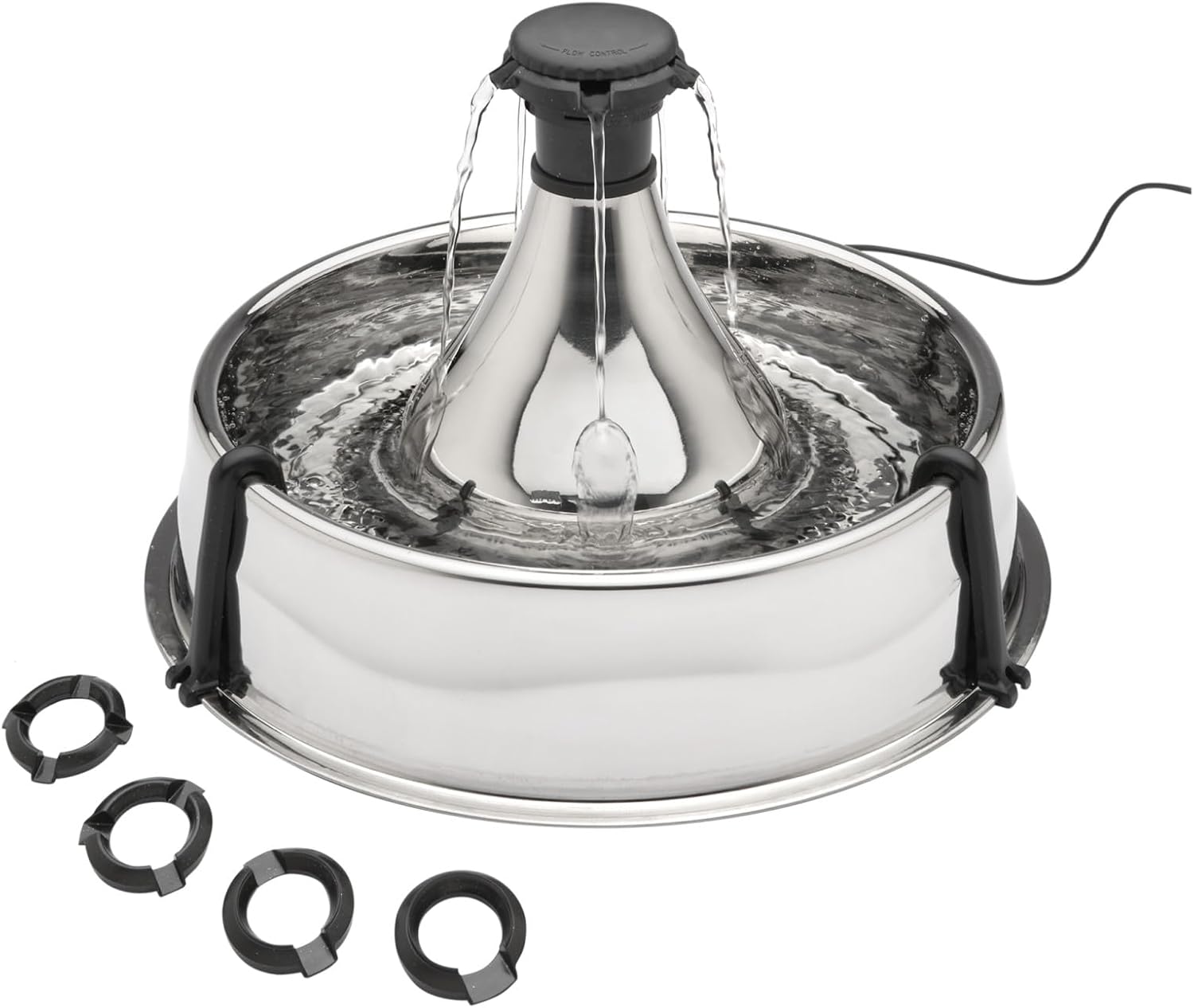
The PetSafe Drinkwell 360 stands out for a different reason: it allows several pets to drink from different sides of the same fountain.
Its 128-ounce capacity, equivalent to one gallon, is the largest among our three picks.
It also has a circular drinking area and interchangeable spout attachments that create different numbers of falling streams.
Rather than requiring every cat to approach a single faucet, the 360-degree design provides access from multiple directions.
This can be convenient for households with several cats or a combination of cats and small dogs.
Why does the 360-degree design matter?
Cats can be particular about where they drink.
In a multi-cat household, one cat may approach the water station while another is already using it.
A narrow drinking area can create an awkward situation where one pet must wait or approach the other closely.
The PetSafe’s circular bowl provides more room, and its multiple water streams may make simultaneous drinking more practical.
However, a larger fountain doesn’t automatically eliminate territorial behavior.
If one cat guards the water station, adding a second fountain or ordinary water bowl in another location may be more helpful than buying one larger unit.
How effective is its filtration?
The Drinkwell 360 uses two filtration components.
An activated carbon filter helps reduce unwanted tastes and odors.
A foam prefilter captures larger debris, including some hair and dirt, before it reaches the pump.
This arrangement is useful in multi-pet homes because loose fur and other debris can accumulate relatively quickly.
However, neither filter removes the need to clean the fountain.
Pet hair, biofilm, and mineral deposits can still accumulate on surfaces and inside the pump.
Is the Drinkwell 360 easy to clean?
The main stainless steel bowl is dishwasher-safe, which is convenient.
The drawback is the number of individual components.
Unlike the relatively straightforward Pioneer Pet Raindrop, the Drinkwell 360 uses a central cone, interchangeable spouts, filter components, and a pump assembly.
All of these need to be removed and cleaned periodically.
Cats.com’s independent review identified the Drinkwell 360 as one of the more complicated fountains to assemble among its tested models.
It also noted that the falling water streams made more noise than some smaller designs.
Neither issue makes the fountain a bad choice, but they’re worth considering if your main goal is minimizing cleaning time.
What about filter replacement costs?
PetSafe sells compatible Drinkwell 360 carbon filters in three-packs.
At a manufacturer reference price of $9.99 per pack, with replacement every two to four weeks, the estimated annual carbon-filter cost is approximately $43–$87.
The foam prefilter also requires periodic replacement, adding to the total.
Check the exact replacement-filter model before ordering because PetSafe sells filters for multiple Drinkwell fountains, and they aren’t all interchangeable.
Pros
- Large 128-ounce capacity
- Stainless steel main bowl
- Multiple drinking positions
- Up to five different water-stream configurations
- Carbon filtration and foam prefilter
- Suitable for households with cats and small dogs
- Replaceable components and established manufacturer support
Cons
- More complicated to disassemble
- More components require cleaning
- Falling streams can be noticeably noisy
- Larger footprint
- Two types of filters to maintain
- Not necessary for many single-cat households
Our verdict: The PetSafe Drinkwell 360 is our recommendation for households with several pets.
Its generous water capacity and multiple drinking positions provide advantages that smaller fountains don’t offer, although the additional cleaning work may not be worthwhile for someone with only one cat.
Feature | |||
|---|---|---|---|
| | | |
Best for | Overall value | Easy cleaning | Multiple cats |
Water capacity | 108 oz (3.2 L) | 60 oz (1.8 L) | 128 oz (3.8 L) |
Stainless steel construction | Main drinking and reservoir surfaces | Main bowl and upper housing | Main bowl and housing |
Flow style | Faucet stream or gentle bubble | Flowing stream and pool | Multiple falling streams |
Adjustable flow options | Two modes | No dedicated adjustable-flow setting | Up to five stream configurations |
Filtration | Carbon and sponge filtration | Replaceable charcoal filter | Carbon filter and foam prefilter |
Dishwasher-safe steel components | Yes | Yes | Yes |
Power | Wall outlet | Wall outlet | Wall outlet |
Main drawback | Narrow spout needs careful cleaning | Smaller capacity | More parts to disassemble |
Price | | | |
4. Which Stainless Steel Cat Fountain Costs Less to Maintain?
The purchase price isn’t the only cost that matters.
Water fountains use electricity, replacement filters, and pumps that may eventually need replacing.
Fortunately, none of the three models requires a subscription or proprietary smartphone service.
The biggest predictable recurring expense is usually filtration.
Fountain | Replacement filter reference price | Suggested interval | Estimated annual filter cost |
|---|---|---|---|
PawsPik SS-01 | $17.99 for 8 sets | Every 2–4 weeks | $29–$58 |
Pioneer Pet Raindrop | $10.99 for 3 | Every 2–4 weeks | $48–$95 |
PetSafe Drinkwell 360 | $9.99 for 3 carbon filters | Every 2–4 weeks | $43–$87, plus foam filters |
Estimated annual costs are rounded and assume 13–26 replacements per year. Prices are manufacturer reference prices checked in October 2026. They exclude shipping, sales tax, electricity, cleaning supplies, replacement pumps, and promotional discounts.
Is a more expensive fountain cheaper in the long run?
Not necessarily.
For example, a fountain with a relatively affordable purchase price may require expensive replacement filters.
Another model might cost more initially but use less expensive consumables.
If you plan to keep the fountain for three years, even a $20 annual filter-cost difference adds up to $60.
That may be more significant than a small difference between two fountains’ purchase prices.
However, consider how easy it is to obtain compatible replacement parts.
Saving a few dollars on filters provides little benefit if you cannot find replacement filters or a suitable pump a year later.
This is one reason established product lines with clearly identified replacement components can be attractive.
5. Stainless Steel vs Plastic Cat Water Fountains: Is Steel Actually Better?
Stainless steel offers several practical advantages over plastic, but it’s important not to exaggerate them.
Stainless steel is durable and nonporous
Food-grade stainless steel doesn’t have the same relatively soft surface characteristics as many plastics.
It can resist scratching, and its smooth surface generally makes cleaning straightforward.
That may be particularly helpful when removing visible residue or mineral deposits.
However, a neglected stainless steel fountain can still accumulate bacteria and biofilm.
The material alone doesn’t make the water sterile.
Plastic fountains aren’t automatically unsafe
A well-made plastic fountain that is cleaned properly can still be suitable for cats.
The problem often arises when plastic develops scratches or areas that are difficult to clean.
Those surfaces may trap residue, especially when the fountain isn’t disassembled regularly.
Some cats also develop chin irritation that owners associate with food or water bowls. However, feline acne has multiple possible contributing factors, and stainless steel shouldn’t be presented as a guaranteed treatment.
If your cat has persistent chin irritation, consult your veterinarian.
Not every stainless steel fountain is entirely steel
This is one of the most overlooked details in fountain marketing.
A product may be described as a stainless steel water fountain even when only the drinking tray is stainless steel.
The reservoir, pump housing, and other water-contact components may still be plastic.
For example, some PETLIBRO Dockstream and PETKIT Eversweet models feature stainless steel drinking trays while using plastic reservoirs.
That doesn’t necessarily make them poor products.
It simply means buyers should distinguish between a stainless steel drinking surface and a fountain whose primary reservoir and drinking basin are stainless steel.
The three models in this guide emphasize stainless steel in their main water-holding structures, although all still use non-metal internal components.
6. How to Clean a Stainless Steel Cat Water Fountain Properly
Even the best fountain needs regular maintenance.
A practical routine doesn’t have to be complicated.
Step 1: Unplug and empty the fountain
Disconnect power before removing any components.
Discard the old water rather than simply topping up a dirty reservoir.
Remove the food-contact parts according to the manufacturer’s instructions.
Step 2: Wash the stainless steel components
Use warm water, a suitable mild dishwashing detergent, and a soft sponge or cloth.
Avoid abrasive steel wool or harsh scrubbers that could damage the finish.
If the manufacturer identifies particular components as dishwasher-safe, they can be cleaned accordingly.
Never place the electrical pump or power adapter in a dishwasher.
Step 3: Disassemble and clean the pump
This is the part many owners overlook.
Hair and residue can accumulate around the pump intake and impeller.
Follow the manufacturer’s instructions for safely removing the pump cover and cleaning the internal parts.
A small cleaning brush may help reach narrow spaces.
Do not force components apart if the manufacturer doesn’t identify them as removable.
Step 4: Inspect the filter
Replace disposable filters according to the recommended interval or sooner if performance declines.
Some filters require rinsing before installation, but disposable carbon filters generally shouldn’t be washed with soap and reused.
Step 5: Refill and check operation
Reassemble the fountain, add fresh water to the appropriate level, and reconnect power.
Confirm that water flows properly and that the pump isn’t running dry.
A loud or rattling pump may indicate low water, trapped air, debris, or improper assembly.
For many households, weekly cleaning is a sensible starting routine, with more frequent water changes and cleaning when needed. Use the manufacturer’s recommendations and adjust for the number of pets and visible buildup.
7. Will a Water Fountain Actually Encourage Your Cat to Drink More?
A fountain may encourage drinking, but it won’t work for every cat.
Cornell University’s Feline Health Center explains that some cats increase their water intake when offered a fountain, while individual preferences vary.
Moving water may appeal to cats that prefer a running faucet or frequently investigate water flowing from a sink.
However, some cats dislike the sound of the pump or the sensation of moving water.
Others prefer a completely still bowl.
How to introduce a new water fountain
Place the fountain near a familiar drinking area, but avoid forcing your cat to use it.
Initially, keep an ordinary water bowl available.
Allow your cat to investigate the new fountain at its own pace.
If the fountain has multiple flow modes, begin with the gentler setting.
You can also position the fountain where your cat feels comfortable rather than in a busy hallway or near a noisy appliance.
For households with multiple cats, offer more than one drinking location to reduce competition.
A fountain doesn’t replace proper hydration care
Even if your cat enjoys the fountain, pay attention to actual drinking habits.
Sudden increases in thirst, decreases in drinking, changes in urination, or signs of illness deserve veterinary attention.
A cat’s water intake also depends on its diet.
Cats eating primarily wet food generally obtain more moisture from their meals than cats eating dry kibble.
A fountain may be a useful addition, but it isn’t a treatment for dehydration, kidney disease, or urinary disorders.
8. Which Stainless Steel Cat Water Fountain Is Best for Your Household?
Your situation | Our recommendation | Why |
|---|---|---|
Want the best overall value | PawsPik SS-01 | Large capacity and two flow modes |
Have one cat and prioritize easy cleaning | Pioneer Pet Raindrop | Simple disassembly |
Have three or more cats | PetSafe Drinkwell 360 | Large capacity and multiple drinking positions |
Your cat likes drinking from the faucet | PawsPik SS-01 | Faucet-style stream |
You dislike complicated cleaning routines | Pioneer Pet Raindrop | Fewer major components |
Want lower estimated filter costs | PawsPik SS-01 | Economical replacement packs |
Have both cats and a small dog | PetSafe Drinkwell 360 | Multi-pet design |
Need battery-powered operation | Consider a separate cordless model | All three picks require wall power |
The most important factors are your cat’s preferences, how many pets share the fountain, and whether you’ll actually maintain the product.
A large stainless steel fountain with an elaborate filter system isn’t necessarily better than a simple bowl if the fountain is difficult to keep clean.
Frequently Asked Questions
What is the best stainless steel cat water fountain?
The PawsPik SS-01 is our best overall recommendation because it combines a large stainless steel reservoir, two drinking styles, accessible components, and reasonably priced replacement filters. The Pioneer Pet Raindrop is better for simpler maintenance, while the PetSafe Drinkwell 360 is more appropriate for multi-pet households.
Are stainless steel cat fountains better than plastic?
Stainless steel is durable, nonporous, and generally easy to clean. However, properly maintained plastic fountains can also be suitable. A stainless steel fountain still needs regular washing and pump maintenance to control buildup.
How often should you clean a stainless steel cat fountain?
Weekly cleaning is a practical starting point for many households, but the appropriate frequency depends on the manufacturer’s instructions, number of animals, water quality, and visible residue. Replace water regularly and clean sooner if you notice slime, debris, unpleasant odors, or reduced water flow.
Can stainless steel cat fountains prevent feline acne?
They may help reduce contact with scratched or difficult-to-clean plastic surfaces, but stainless steel isn’t a guaranteed way to prevent or treat feline acne. Persistent irritation or lesions should be evaluated by a veterinarian.
Are stainless steel cat water fountains dishwasher-safe?
Many models have dishwasher-safe stainless steel bowls or trays, including the three discussed here. However, electronic pumps, power supplies, and certain other components must be cleaned separately. Always follow the instructions for the exact model.
How often do cat fountain filters need replacing?
Many manufacturers recommend replacing carbon filters every two to four weeks. Foam prefilters may have different replacement intervals. Check the specific manufacturer’s instructions and replace components sooner when necessary.
Do cat water fountains use a lot of electricity?
Most small cat fountains use low-voltage pumps that consume relatively little electricity compared with larger household appliances. Actual consumption depends on the pump and operating time. The three models in this guide require a power connection.
Can I leave a cat water fountain running all day?
These products are designed for ongoing circulation when correctly assembled and filled, but they still need regular inspection. Never allow the pump to run dry, and don’t rely on a fountain as your cat’s only source of water during an extended absence.
Do I need a separate water fountain for each cat?
Not necessarily. Several cats may comfortably share a large fountain. However, providing multiple water locations can help prevent resource guarding and ensure that shy or less assertive cats have access to water.
Final Verdict: Which Stainless Steel Cat Fountain Should You Buy?
For most cat owners, the PawsPik SS-01 is the best stainless steel cat water fountain of these three options.
Its large capacity, choice of drinking modes, stainless steel construction, and comparatively economical replacement filters offer a practical balance of features and ownership costs.
However, there are two situations where we’d recommend a different model.
If your main priority is keeping cleaning as simple as possible, choose the Pioneer Pet Raindrop. It has fewer major components, a compact design, and dishwasher-safe stainless steel surfaces. Its smaller capacity is the principal trade-off.
If several cats share a water station, choose the PetSafe Drinkwell 360. The large reservoir and multiple drinking streams make it better suited to households where several animals may approach the fountain throughout the day.
Whichever model you choose, remember that stainless steel doesn’t eliminate maintenance.
The best fountain is one your cat enjoys drinking from and that you can comfortably keep clean.
That’s more important than having the largest reservoir, the fanciest filter, or the most impressive feature list.
Sources and Research Methodology
This article is based on manufacturer specifications, replacement-part documentation, and independent published testing. It does not claim that PetsPal conducted hands-on testing.
- PawsPik SS-01 product specifications: https://pawspik.com/products/ss-cat-water-fountain
- PawsPik SS-01 replacement filters: https://pawspik.com/products/filters-pet-water-fountain
- Pioneer Pet Raindrop specifications: https://pioneerpet.com/
- Pioneer Pet replacement filters: https://pioneerpet.com/product/pioneer-pet-replacement-filters-for-ceramic-stainless-steel-fountains/
- PetSafe Drinkwell 360 replacement filters: https://www.petsafe.com/p/drinkwell-360-charcoal-filters-3-pack/PAC00-13712/
- Cats.com, Best Cat Water Fountains (2026): https://cats.com/best-cat-water-fountain
- Cornell Feline Health Center, Hydration: https://www.vet.cornell.edu/departments-centers-and-institutes/cornell-feline-health-center/health-information/feline-health-topics/hydration
Manufacturer prices, available filters, and replacement schedules should be reviewed periodically because they may change.