
I'm a participant in the Amazon Services LLC Associates Program, an affiliate advertising program designed to provide a means for me to earn fees by linking to Amazon.com and affiliated sites.
If your dog struggles to jump onto the couch or hesitates before climbing into bed, you’ve probably considered buying a set of dog stairs or a ramp.
Both products promise to make furniture easier to access, but they aren’t interchangeable. The wrong choice can be too steep, too narrow, or too uncomfortable for your dog to use.
For most senior dogs and dogs with joint or back problems, a gently sloped ramp is the better starting point. Dog stairs are often more practical for smaller, healthy dogs that can climb comfortably but need help reaching higher furniture.
However, not every ramp is gentler than every staircase. A short, steep ramp can be harder to navigate than a set of wide, shallow steps.
Your dog’s size, mobility, confidence, and the height of your furniture all matter.
Here’s how to choose between dog ramps and dog stairs, including what to look for, how to measure your furniture, and how to help your dog use the new equipment.
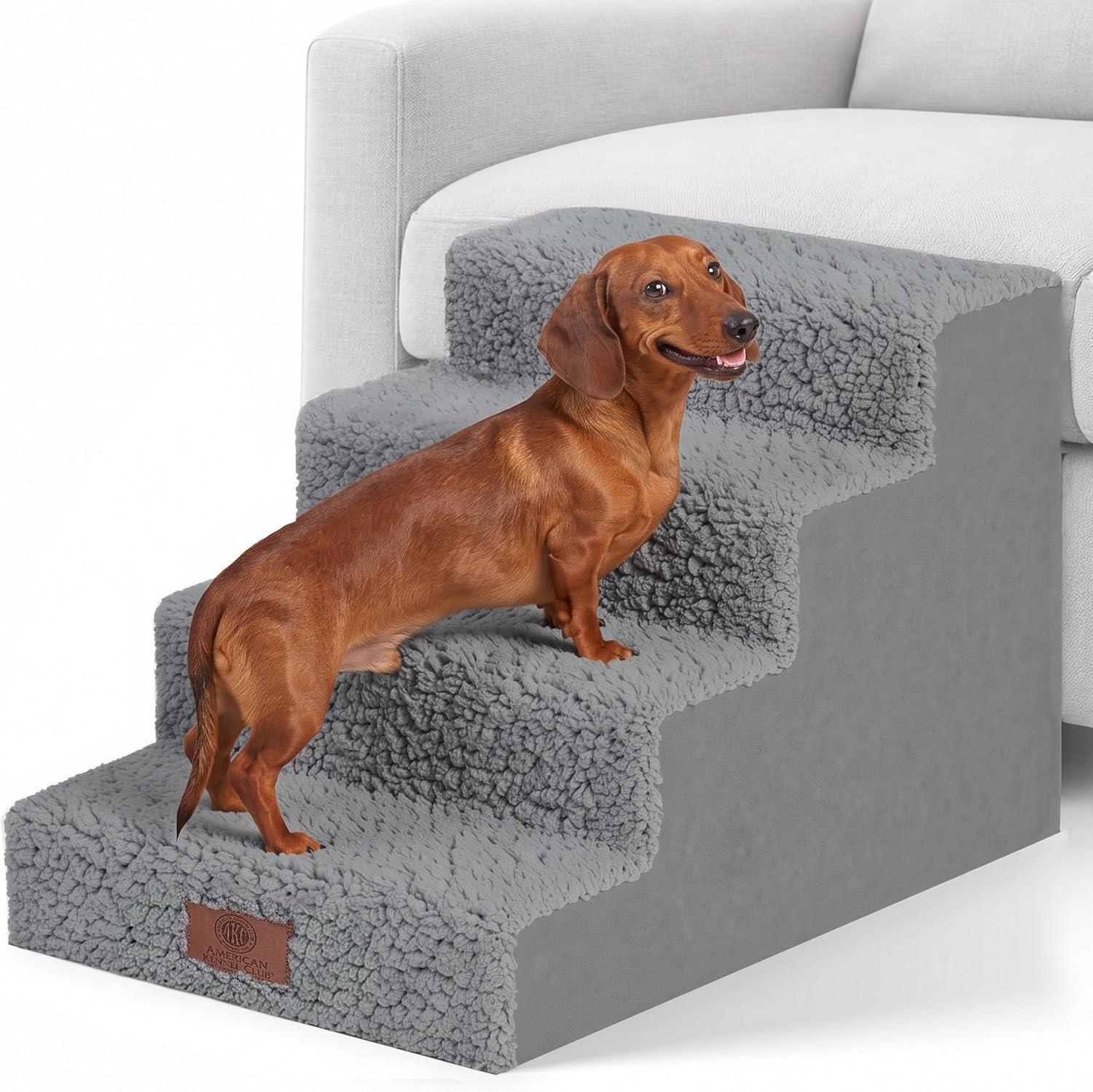
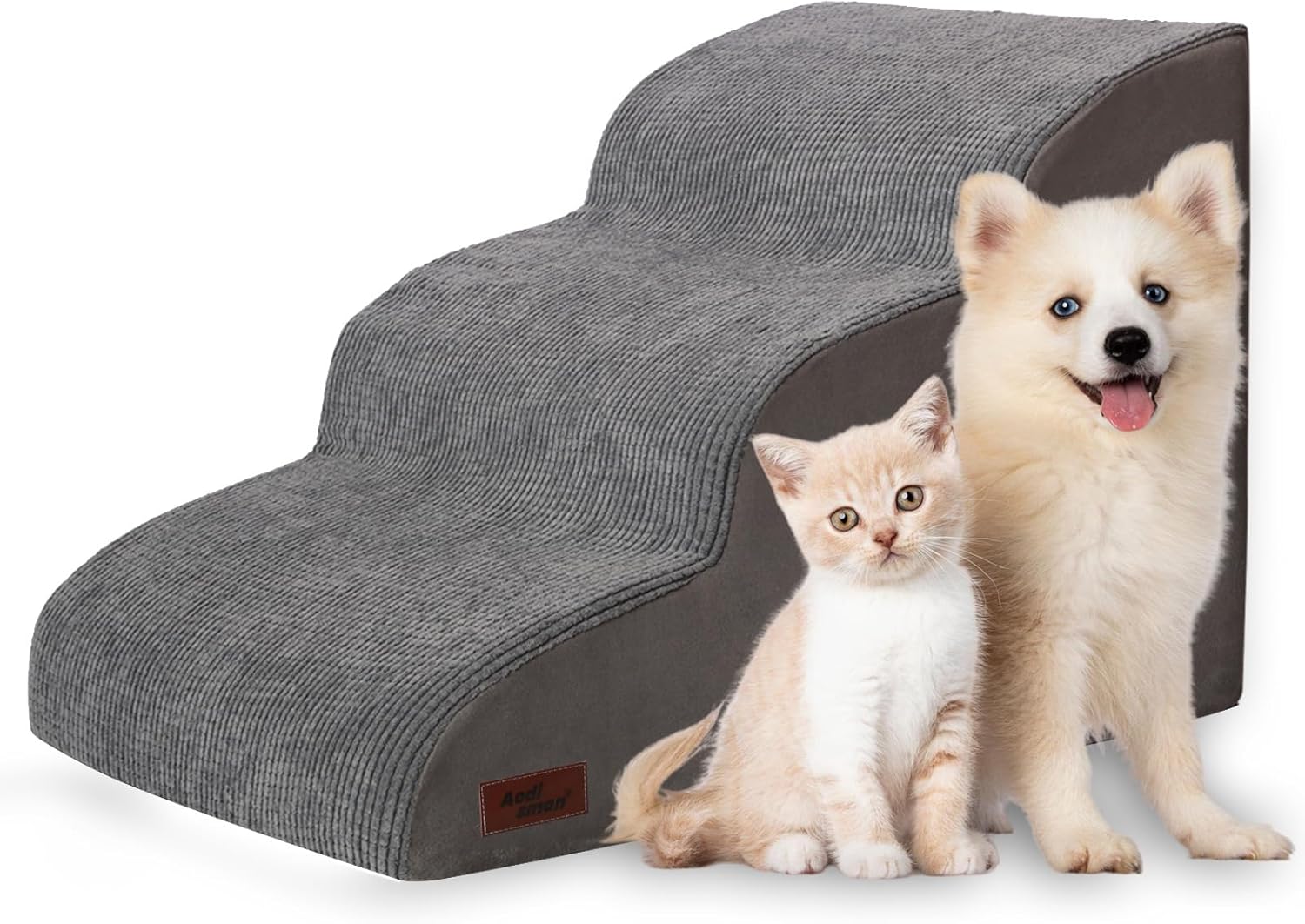
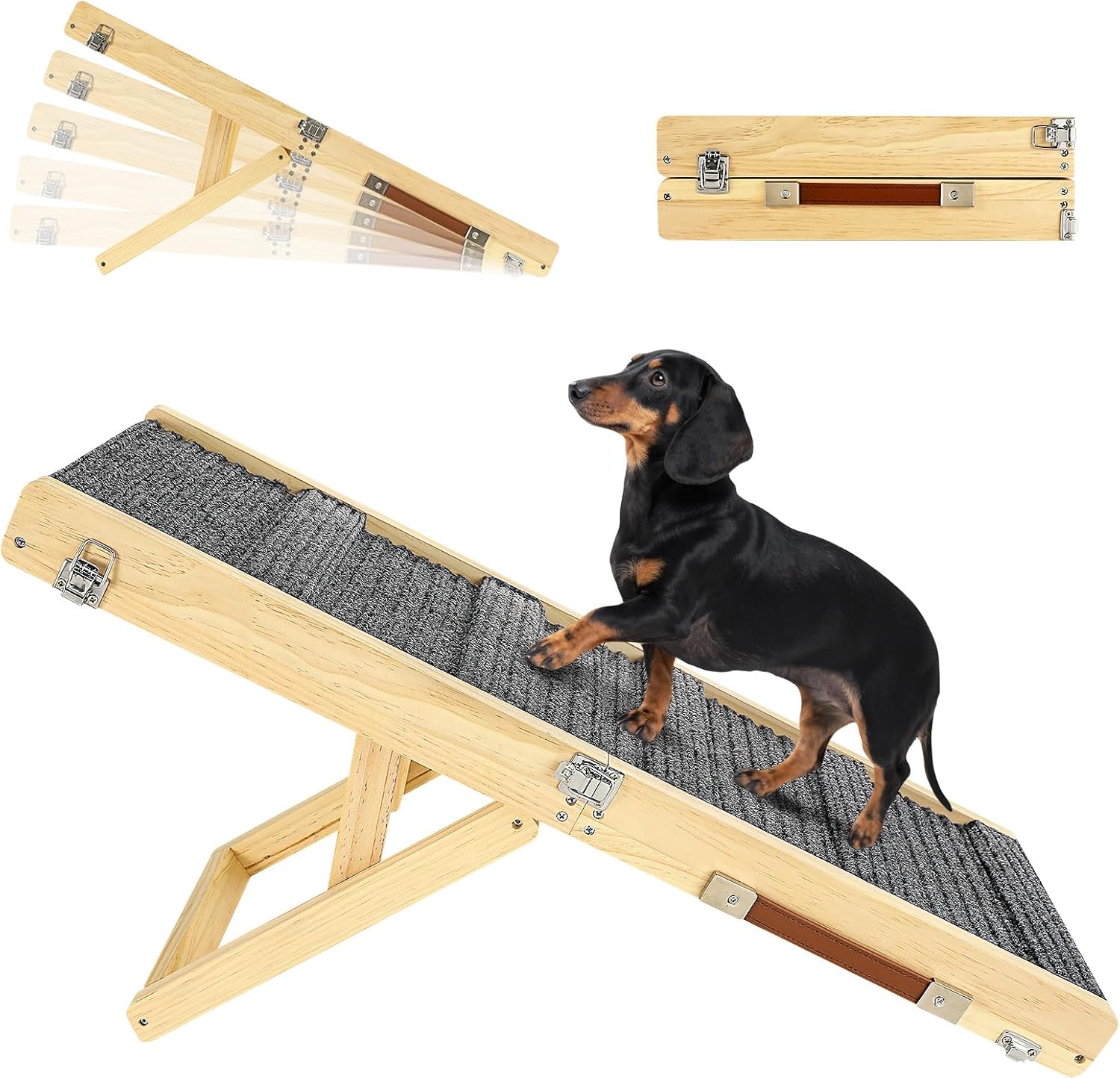
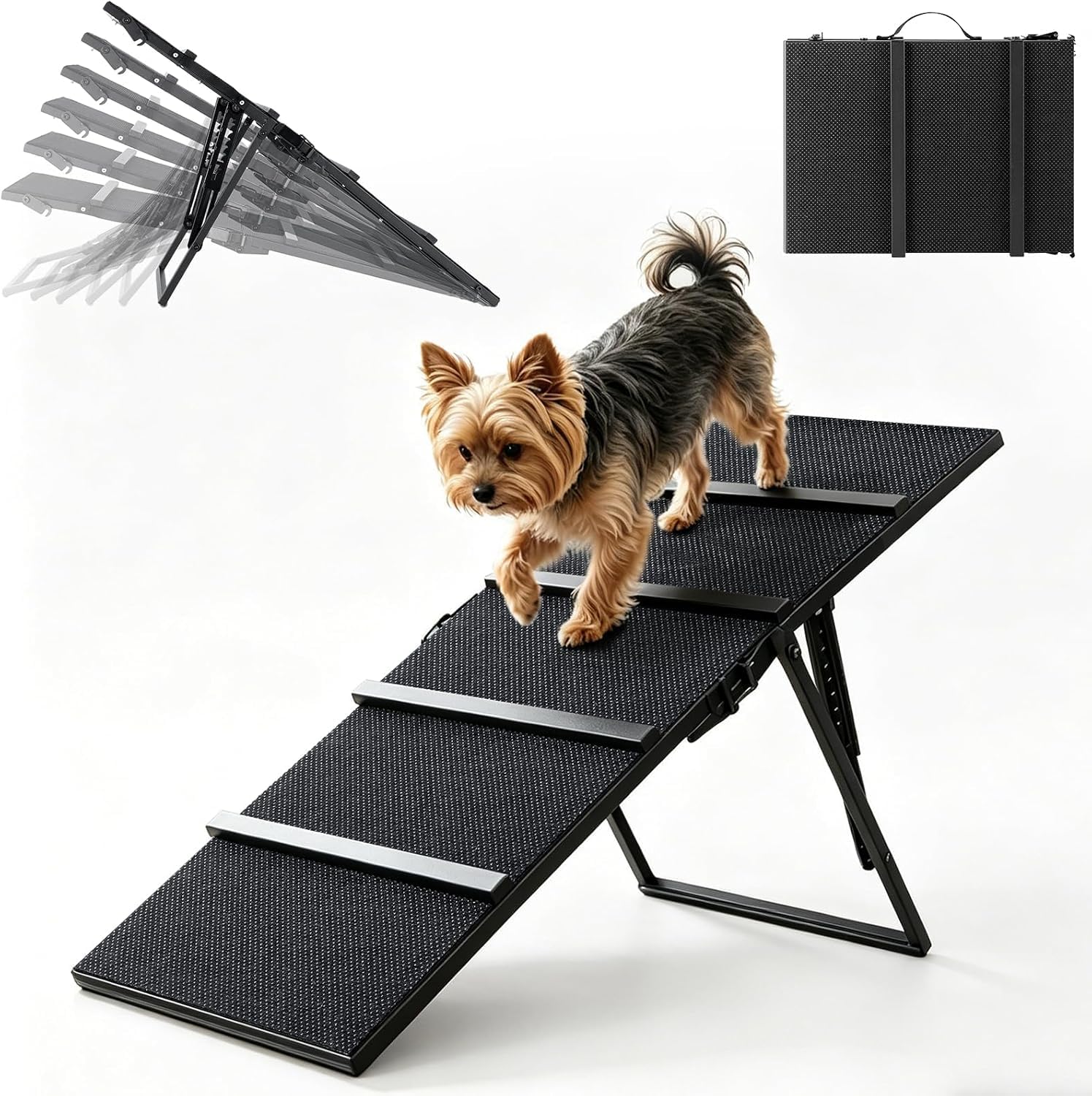

Quick Verdict: Dog Ramp vs Dog Stairs
Feature | Dog Ramp | Dog Stairs |
|---|---|---|
Best for | Senior dogs, joint discomfort, reduced mobility | Small, agile dogs with good mobility |
Movement | Continuous inclined surface | Repeated stepping |
Joint considerations | Can reduce the need for large step movements | Requires bending and extending joints |
Floor space | Often needs more length | Usually more compact |
Ideal furniture | Beds, sofas, elevated surfaces | Lower sofas and beds |
Ease of storage | Many fold or collapse | Some fold; foam models can be bulky |
Traction | Requires a nonslip walking surface | Requires nonslip, stable steps |
Main drawback | Can become too steep or take up too much room | Step height may be uncomfortable |
Our recommendation: Choose a long, stable ramp with a gentle slope if your dog has difficulty using stairs, has reduced mobility, or needs to avoid jumping. Choose deep, low-rise stairs for a healthy smaller dog that comfortably handles steps and where floor space is limited.
For dogs with diagnosed arthritis, spinal disease, or recent surgery, your veterinarian should help determine the most appropriate mobility aid.
1. Are Dog Ramps or Dog Stairs Better for Your Dog’s Joints?
One of the main reasons people buy dog ramps or stairs is to reduce the physical impact of jumping.
Jumping onto a bed requires a dog to propel its body upward, while jumping down involves landing forces that are absorbed through the legs and joints.
For a healthy young dog, occasional jumping may not cause obvious problems. However, repeated jumping can be uncomfortable for dogs with existing mobility limitations.
According to veterinary guidance published by PetMD, both ramps and stairs can reduce the strain associated with jumping onto elevated furniture. Ramps are generally preferable for dogs with arthritis or back problems because they avoid repeated step-up movements.
Why ramps can be easier on the joints
A ramp provides a continuous walking surface.
Rather than lifting the body from one step to another, your dog walks up or down an incline.
When the incline is gentle and the surface provides good traction, this can reduce the need for large movements at the hips, knees, and other joints.
For example, an older Labrador Retriever with stiff hind legs may find walking up a gradual ramp easier than climbing several individual steps.
However, the ramp must be appropriately designed.
A steep incline may require considerable effort, especially when climbing upward. Going down a steep ramp can also feel unstable.
A poorly designed ramp isn’t automatically safer just because it doesn’t have steps.
When stairs can work well
Dog stairs divide the height of a bed or sofa into smaller sections.
This can make them useful for dogs that have no difficulty climbing stairs but cannot comfortably make a full jump onto furniture.
For instance, a healthy Yorkshire Terrier may easily climb four shallow steps to reach a bed, even though the bed itself is too high to jump onto comfortably.
The important factors are the height, depth, and stability of each step.
Tall, narrow stairs can still require considerable joint movement and may be difficult for dogs with short legs or poor balance.
Winner: Ramps for dogs with mobility limitations, provided the incline is gentle. Stairs remain a good option for healthy dogs that can comfortably climb them.
2. Dog Ramps vs Stairs for Senior Dogs
Older dogs often experience changes in strength, flexibility, balance, and confidence.
A dog that once jumped effortlessly onto the couch may begin hesitating, using its front legs to pull itself upward, or waiting for someone to lift it.
These changes aren’t always simply part of normal aging.
They can indicate discomfort, arthritis, weakness, or another medical condition that deserves veterinary attention.
Why a ramp is usually preferable
For many senior dogs, a ramp provides a more gradual transition between the floor and an elevated surface.
It can eliminate the need to jump and reduce the amount of stepping required.
However, an older dog with poor balance may struggle with a narrow ramp, particularly if it lacks side rails or an effective gripping surface.
Look for a ramp that is wide enough to let your dog walk naturally without needing to place its paws close to the edges.
The ramp should also remain completely stable when your dog uses it.
When stairs may still work
Not all senior dogs require ramps.
Some older dogs maintain good strength and balance and are comfortable walking on steps.
For these dogs, a set of wide, shallow stairs may be sufficient for reaching a low couch.
The American Kennel Club notes that senior dogs that remain relatively agile may benefit from dog stairs, while dogs with greater mobility limitations often need ramps.
Our recommendation: For senior dogs that hesitate, stumble, or show stiffness when climbing, consider a ramp and seek veterinary guidance rather than assuming a different set of stairs will solve the problem.
3. Which Is Better for Dachshunds, Corgis, and Other Short-Legged Dogs?
Dogs with long backs and short legs have particular considerations when climbing furniture.
Dachshunds, Corgis, and some other breeds are predisposed to spinal conditions, including intervertebral disc disease (IVDD).
These dogs may benefit from furniture access that reduces the need for large jumps.
Why ramps are often recommended
A properly designed ramp lets a short-legged dog move between the floor and furniture without repeatedly climbing high steps.
This can make a difference when the dog’s legs are relatively short compared with the height of the couch or bed.
For example, a 7-inch step may look small to a person but can require substantial movement from a Dachshund.
Several smaller steps may be easier than a single jump, but a sufficiently gentle ramp often offers a more continuous route.
However, it’s important not to overstate the evidence.
Using a ramp doesn’t guarantee that a Dachshund will never develop IVDD, and the relationship between ordinary activity, jumping, and spinal disease is complex.
A ramp is a practical way to manage furniture access, not a proven method of completely preventing disc disease.
What if your dog already has IVDD?
If your dog has diagnosed IVDD, follow your veterinarian’s specific activity restrictions.
During some stages of treatment or recovery, even using a ramp or stairs may be inappropriate.
Do not assume that giving your dog a ramp means it can safely climb onto the furniture whenever it wants.
Sudden weakness, difficulty walking, dragging paws, or loss of bladder control requires urgent veterinary assessment.
Winner: Usually a gently sloped ramp for short-legged dogs where avoiding large jumps is the goal.
4. Dog Ramp vs Stairs for a Couch: Which Makes More Sense?
For a typical living room sofa, dog stairs can be a very practical option.
Couches are generally lower than beds, and stairs often take up less floor space than a ramp designed with a gentle incline.
However, your dog’s mobility should determine the choice.
Choose dog stairs for a couch if:
- Your dog is small and comfortably climbs ordinary steps.
- The couch is relatively low.
- You have limited space in front of the furniture.
- The steps are deep and low enough for your dog’s natural movement.
- Your dog is confident using steps.
A stable three- or four-step staircase may work well for a healthy small dog.
Choose a dog ramp for a couch if:
- Your dog is older or has reduced mobility.
- Your dog has difficulty lifting its back legs.
- You want to avoid repeated jumping.
- Your dog is uncomfortable with stairs.
- You have enough room for a gentle incline.
A ramp may also be preferable if your dog tends to jump directly off the couch rather than descend the steps.
However, whichever product you choose, placement matters.
Position it where your dog naturally approaches the furniture. If it’s tucked away in a corner, your dog may simply keep jumping from the usual spot.
For dogs that need to avoid jumping, supervision or environmental management may be necessary while they learn the new routine.
5. Dog Ramp vs Stairs for a Bed: Why Height Matters More
Beds create a different challenge.
Many modern bed frames, mattresses, and box springs place the sleeping surface considerably higher than a typical sofa.
That means a mobility aid needs to cover more vertical distance.
A short ramp reaching a tall bed may become too steep, while compact pet stairs may have steps that are too high.
Why a longer ramp may be necessary
The taller the furniture, the longer a ramp generally needs to be to maintain a gentle incline.
This is an important buying consideration because manufacturers sometimes advertise a ramp as suitable for beds without explaining how steep it becomes at different heights.
A ramp that feels comfortable against a low sofa might be uncomfortable against a 30-inch-high bed.
If you have enough room, a longer ramp with a gentle slope can be an excellent option.
But in a small bedroom, it may extend too far into the walking area.
When stairs are more practical
Stairs generally have a shorter overall footprint.
If your dog can climb steps comfortably, a staircase with adequate depth and low step height may fit better beside the bed.
Avoid choosing stairs based on the number of steps alone.
Four tall steps can be harder for a small dog than six shorter ones.
Our recommendation: For tall beds, measure carefully before deciding. A properly sized ramp is preferable when your dog needs a low-impact route, but shallow stairs may be more practical for a healthy, agile dog in a small room.
6. How to Measure for Dog Ramps and Stairs
This is one of the most important steps before buying.
You don’t want to purchase a product that looks suitable in a photograph only to discover it doesn’t reach the furniture or creates an uncomfortable incline.
Start with three measurements.
Measurement 1: Furniture height
Measure vertically from the floor to the surface your dog needs to reach.
For a sofa, measure to the top of the seat cushion.
For a bed, measure to the top of the mattress.
Don’t measure only the height of the frame.
Measurement 2: Available floor space
Measure how far a ramp or staircase can extend into the room without blocking normal movement.
Consider doorways, walking routes, and other furniture.
Remember that a ramp may need considerably more horizontal distance than stairs.
Measurement 3: Your dog’s usable walking width
Consider your dog’s shoulder width and normal walking posture.
A product that technically supports your dog’s weight may still be too narrow.
Your dog should be able to turn toward the ramp and walk along it comfortably without constantly approaching the edges.
Understanding ramp steepness
The diagram below illustrates why ramp length matters.
Example: A bed that is 24 inches high
Horizontal floor run | Approximate incline | Practical interpretation |
|---|---|---|
24 inches | 45° | Very steep |
48 inches | 27° | Steep for many dogs |
72 inches | 18° | More gradual |
96 inches | 14° | Gentler but requires more space |
These are geometry examples, not universal veterinary-prescribed safe angles. The actual walking-surface length is greater than the horizontal run, and individual dogs may need a gentler configuration.
A dog with arthritis, weakness, or a spinal condition may have different requirements from a healthy dog.
The general principle is simple: a longer ramp creates a gentler incline when reaching the same furniture height.
What should you measure for dog stairs?
For stairs, pay attention to:
- Total height: The staircase should reach the furniture appropriately.
- Step rise: How high your dog must lift itself at each step.
- Step depth: How much room your dog has to place its paws.
- Width: Enough space to climb and descend confidently.
- Stability: No tipping, sliding, or excessive compression.
The staircase should also meet the furniture without creating an awkward final jump.
7. Foam Dog Stairs vs Hard Steps vs Wooden Ramps
The material can make just as much difference as the overall shape.
Foam dog stairs
Foam stairs are popular because they’re lightweight and often covered with removable fabric.
They may work well for small, healthy dogs that prefer softer surfaces.
However, some foam stairs compress under weight.
If the steps become unstable, tilt, or change shape significantly, they can be difficult for dogs with mobility problems.
Foam stairs are not automatically orthopedic simply because they feel soft.
Choose them based on stability and suitability for your dog’s weight, not comfort claims alone.
Hard plastic or wooden dog stairs
Rigid stairs generally maintain their shape better under load.
This can make them more appropriate for larger dogs, provided they have sufficient strength and traction.
However, hard surfaces can become slippery.
Look for securely attached carpet, textured rubber, or other nonslip material on every step.
Wooden dog ramps
Wooden ramps are often designed to blend into bedroom or living room furniture.
They can be sturdy and attractive, especially when fitted with carpet or textured walking surfaces.
However, some are heavy and difficult to move.
If you plan to use a ramp in multiple locations, consider an adjustable or folding model instead.
Adjustable ramps
Adjustable ramps allow you to change the height and incline.
This can be useful when moving between a lower sofa and a higher bed.
However, the ramp must lock securely at the selected position.
A ramp that shifts or collapses while your dog is using it creates a serious fall risk.
8. The Five Features That Matter Most When Buying
Whether you choose stairs or a ramp, prioritize these features.
1. A nonslip surface
Traction is essential.
Carpet, textured rubber, or purpose-designed gripping surfaces help prevent paws from sliding during use.
Avoid smooth plastic or polished wood walking surfaces unless they include effective traction material.
2. Stable construction
The product should not wobble, tip, slide, or shift when your dog steps onto it.
A ramp or staircase that moves unexpectedly may frighten your dog and increase the chance of falling.
3. Appropriate width
Narrow products can be especially difficult for larger or less confident dogs.
The walking surface should provide enough room for a natural gait.
4. Suitable height and incline
A ramp must be long enough to avoid an excessively steep slope.
For stairs, each step should be comfortably manageable for your dog’s leg length and mobility.
5. Adequate weight capacity
Check the manufacturer’s weight rating.
A product designed for a 20-pound dog isn’t suitable for a 65-pound dog simply because the larger dog can physically fit on it.
Consider both the weight rating and the structural stability of the product.
The American Kennel Club and Canine Arthritis Resources and Education emphasize traction, appropriate width, sufficient strength, and stability when choosing mobility aids.
9. How to Teach Your Dog to Use a Ramp or Stairs
Buying the right product won’t help much if your dog refuses to use it.
Some dogs adapt immediately. Others are hesitant about unfamiliar surfaces, changes in elevation, or the sensation of walking on a ramp.
Gradual training can make the transition easier.
Step 1: Introduce the product without pressure
Place the ramp or stairs in a familiar area.
Allow your dog to sniff and investigate.
Reward calm exploration.
Don’t push or pull the dog onto the equipment.
Step 2: Practice at a low height
For an adjustable ramp, begin with a very gentle incline.
For stairs, practice with low steps if possible.
Use treats or another reward to encourage voluntary movement.
Step 3: Reward individual movements
Don’t expect your dog to immediately climb to the top.
Reward approaching, placing paws on the equipment, and taking a few comfortable steps.
Keep sessions short.
Step 4: Practice descending
Going down can be more intimidating than going up.
Some dogs are comfortable climbing onto the couch but hesitate when they look toward the floor.
Practice descending slowly and use rewards to encourage controlled movement.
Step 5: Make the new route habitual
Position the ramp or stairs at the furniture location your dog normally uses.
Reward choosing the new route rather than jumping.
If your dog has been instructed by a veterinarian not to jump, supervise furniture access until the new routine is reliable.
Never force a frightened dog to use a ramp or staircase. If your dog remains uncomfortable, reassess the angle, surface, stability, or underlying mobility concerns.
10. When Neither a Ramp Nor Stairs Is the Right Solution
A mobility aid isn’t always sufficient.
If your dog has severe weakness, poor balance, substantial pain, or difficulty walking independently, even a gentle ramp may be challenging.
For some dogs, a floor-level sleeping area is safer than continued access to a high bed.
You might also consider a supportive orthopedic dog bed positioned near your own sleeping area.
Other dogs may benefit from a properly fitted support harness or sling under veterinary guidance.
Don’t assume that every dog should continue accessing elevated furniture just because a ramp or staircase is available.
If your dog suddenly begins refusing stairs, yelps when moving, limps, drags its feet, or shows new weakness, arrange veterinary evaluation.
A sudden mobility change is not something to solve with a product purchase alone.
11. Which Should You Buy? Recommendations by Dog and Furniture Type
Your situation | Our recommendation |
|---|---|
Healthy Chihuahua reaching a low couch | Shallow dog stairs |
Senior Labrador with stiffness | Gentle, wide ramp |
Dachshund accessing a bed | Ramp, subject to veterinary guidance |
Healthy small dog and limited bedroom space | Deep, low-rise stairs |
Dog with arthritis | Ramp, with veterinarian’s advice |
Large dog accessing a high bed | Sturdy, sufficiently long ramp |
Dog uncomfortable walking on an incline | Evaluate shallow stairs or another arrangement |
Dog recovering from spinal surgery | Follow the veterinarian’s activity restrictions |
Dog that keeps jumping off the furniture | Train the new route and manage access |
The goal isn’t to purchase the product with the most features.
It’s to provide a route your dog can use comfortably, confidently, and consistently.
Frequently Asked Questions
Are dog ramps or stairs better for older dogs?
Ramps are generally preferable for older dogs with arthritis, stiffness, or reduced mobility because they can reduce the need for repeated stepping. However, some senior dogs are comfortable with wide, shallow stairs. The best choice depends on the dog’s physical condition and the product’s design.
Are ramps better than stairs for Dachshunds?
A gently sloped ramp is often a practical choice for Dachshunds because of their short legs and susceptibility to spinal problems. However, a ramp doesn’t guarantee prevention of IVDD. Dogs with diagnosed spinal disease should follow their veterinarian’s activity recommendations.
Do dog stairs help prevent joint problems?
Dog stairs reduce the need for a full jump onto or off furniture, but they don’t eliminate joint movement or impact. There isn’t strong evidence that purchasing stairs alone prevents arthritis or other joint conditions. Appropriate exercise, healthy weight, and veterinary care remain important.
What is the best ramp angle for a dog?
There isn’t one universally safe angle for every dog. A gentle slope is generally preferable, especially for dogs with mobility problems. The appropriate incline depends on the dog’s size, strength, diagnosis, balance, and comfort. Measure your furniture and floor space, and consult your veterinarian for medical mobility needs.
Are foam dog stairs safe for large dogs?
Some are designed for larger dogs, but foam can compress or become unstable under weight. Check the manufacturer’s weight capacity and confirm that the steps remain firm and level during use. Rigid stairs or a sturdy ramp may be more suitable for a heavier dog.
How many stairs does a dog need for a bed?
The number depends on the bed’s height and the rise of each step. More steps can provide a gentler climb when each step is low and sufficiently deep. Focus on step dimensions rather than buying according to a specific number of steps.
Should a dog use a ramp after surgery?
Only if the veterinarian approves it. Some surgical recovery plans require strict activity restrictions, and climbing onto elevated furniture may be prohibited even with a ramp.
Can dogs use human stairs to get onto a couch?
Standard household stairs are not designed as portable furniture-access products. Using improvised steps or unstable objects can create a fall risk. Choose a purpose-built, appropriately rated product or a securely constructed alternative.
Are dog ramps worth the money?
They can be worthwhile when they help a dog access furniture without uncomfortable jumping or climbing. The benefit is especially meaningful for dogs with mobility limitations, provided the ramp is suitable and the dog uses it consistently.
What if my dog refuses to use a ramp?
Begin with gradual positive reinforcement training and make sure the ramp is stable, wide enough, and not too steep. If your dog continues to avoid it, consider whether pain, fear, poor traction, or the design itself is contributing to the problem.
Final Verdict: Dog Ramp vs Dog Stairs
For dogs with arthritis, reduced mobility, or difficulty climbing, a stable ramp with a gentle incline is generally the better option.
It provides a continuous walking surface and can reduce the need for repeated stepping or jumping.
However, dog stairs are often more convenient for healthy small dogs that simply need help reaching a couch or bed.
They take up less floor space and may be easier to fit into smaller rooms.
The biggest mistake is assuming that every ramp is safer than every set of stairs.
A steep, slippery ramp can be difficult to use, while a well-designed staircase with low, deep steps may be comfortable for an agile dog.
Before buying, measure your furniture, evaluate your dog’s mobility, and check the product’s dimensions and weight capacity.
Most importantly, introduce the equipment gradually so your dog learns to use it confidently.
The best choice is the one that provides a secure, comfortable route to your dog’s favorite resting place without creating a new risk of slipping, falling, or struggling.
Sources and Research Methodology
This article uses veterinary and established pet-care guidance. It is an educational comparison, not a hands-on evaluation of specific ramp or stair products.
- American Kennel Club, Dog Stairs vs. Ramps: Choosing the Right Option for Your Dog: https://www.akc.org/expert-advice/health/dog-stairs-and-ramps/
- PetMD, Does My Dog Need Dog Stairs or a Dog Ramp? https://www.petmd.com/dog/general-health/does-my-dog-need-dog-stairs-dog-ramp
- Canine Arthritis Resources and Education, Assistive Devices: https://caninearthritis.org/article/assistive-devices/
- VCA Animal Hospitals, Helping Your Dog with Osteoarthritis: https://vcahospitals.com/st-marys/know-your-pet/helping-your-dog-with-osteoarthritis
- American Kennel Club, Making Your Home More Accessible for a Senior Dog: https://www.akc.org/expert-advice/health/making-home-accessible-for-senior-dog/