I'm a participant in the Amazon Services LLC Associates Program, an affiliate advertising program designed to provide a means for me to earn fees by linking to Amazon.com and affiliated sites.
PETSPAL.ORG | CAT FEEDERS & PET TECHNOLOGY
If you have more than one cat, you probably know how frustrating feeding time can become. One cat finishes its food in seconds and heads straight for the other cat’s bowl. Meanwhile, the slower eater walks away hungry, or a cat on a special diet ends up eating food it shouldn’t.
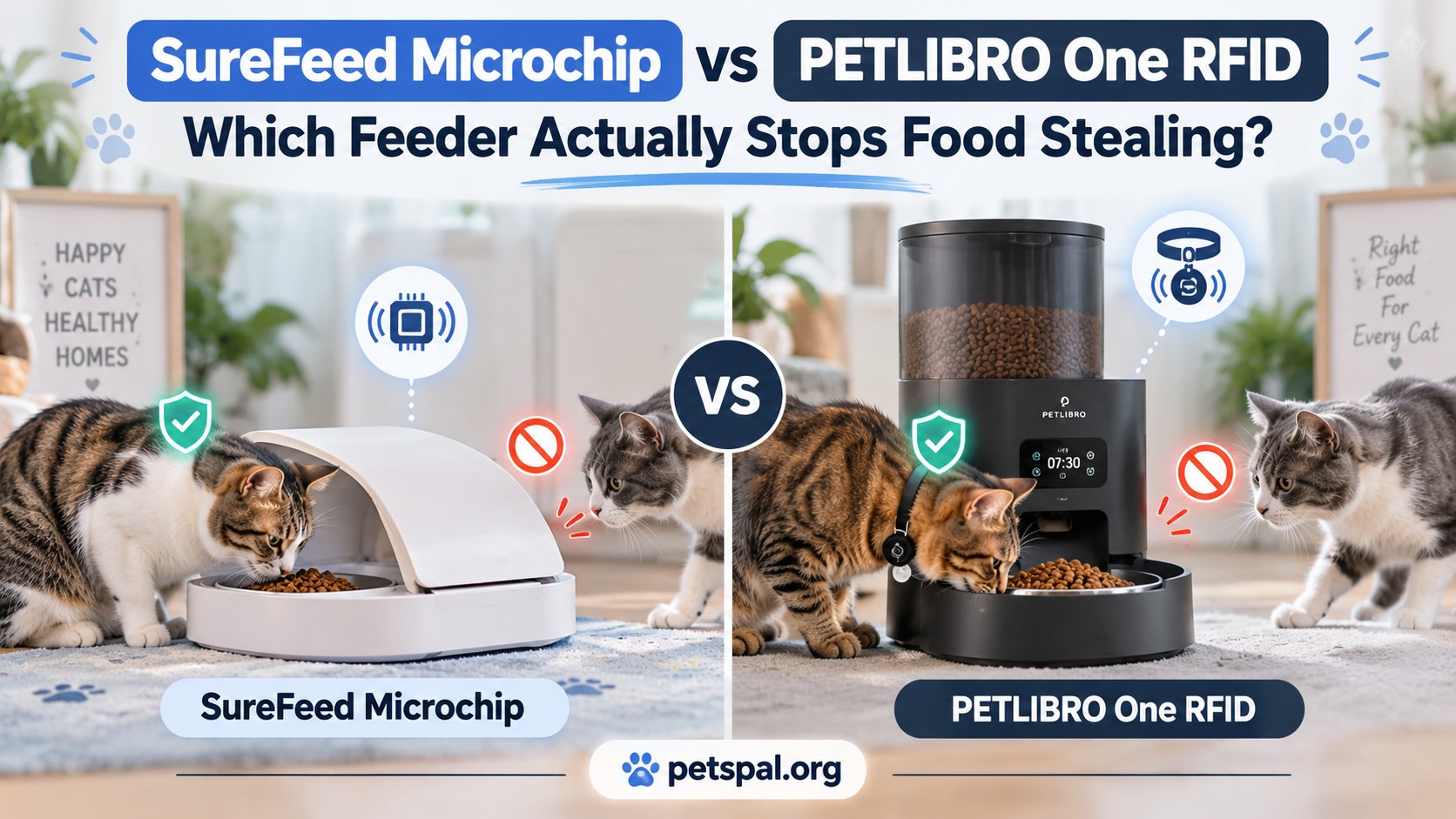
The SureFeed Microchip Pet Feeder and PETLIBRO One RFID Smart Feeder both aim to solve this problem by restricting access to food. However, they work very differently.
SureFeed recognizes your cat’s implanted microchip and opens a covered food bowl. PETLIBRO uses a special RFID collar tag to identify the cat and automatically dispenses scheduled portions of dry food.
That distinction matters more than it might first appear. One feeder is better for protecting meals you’ve already prepared, while the other is designed to control both who eats and when food is served.
So which is better for a household with food-stealing cats? Here’s how they compare.
Quick verdict: SureFeed vs PETLIBRO One RFID


SureFeed Microchip Pet Feeder
Best for wet food, prescription diets, and cats that don’t wear collars.
SureFeed is our preferred choice when the main goal is keeping another pet out of a specific food bowl. It works with compatible implanted microchips, doesn’t need Wi-Fi, and supports wet or dry food.

PETLIBRO One RFID Smart Feeder
Best for scheduled dry-food feeding and app-based meal management.
PETLIBRO is the better option if you want to automate feeding times while restricting access to a designated cat. Its three-liter hopper, scheduled portions, and app-based feeding records make it particularly appealing for busy households.
Our recommendation: Choose SureFeed if food stealing is your main problem, especially if your cat eats wet food or cannot comfortably wear a collar. Choose PETLIBRO if you want automatic dry-food portions and your cat is comfortable wearing its dedicated RFID tag.
Neither feeder is completely theft-proof. Another cat may attempt to sneak in while the lid is open, so introducing the feeder and observing how your cats behave around it is important.
SureFeed Microchip vs PETLIBRO One RFID: Comparison table
Feature | ||
|---|---|---|
 |  | |
Feeder type | Protected food bowl | Automatic dry-food dispenser |
Identification | Implanted microchip or SureFlap tag | Dedicated PETLIBRO RFID collar tag |
Food compatibility | Wet and dry | Dry kibble only |
Food capacity | 400 ml bowl | 3 L hopper |
Scheduled feeding | No | Up to 10 meals daily |
Smartphone app | No, standard model | Yes |
Power | 4 C batteries | Power adapter, 3 D backup batteries |
Number of recognized pets | Up to 32 | One paired tag per feeder |
Best use | Preventing access to prepared meals | Scheduled, individualized dry meals |
Price | | |
Specifications refer to the standard SureFeed Microchip Pet Feeder, not SureFeed Connect, and PETLIBRO One RFID model PLAF301. Sources: Sure Petcare and PETLIBRO.
1. Microchip vs RFID: The biggest difference
The first thing to understand is that these two feeders do not identify cats in the same way.
SureFeed recognizes your cat’s implanted microchip
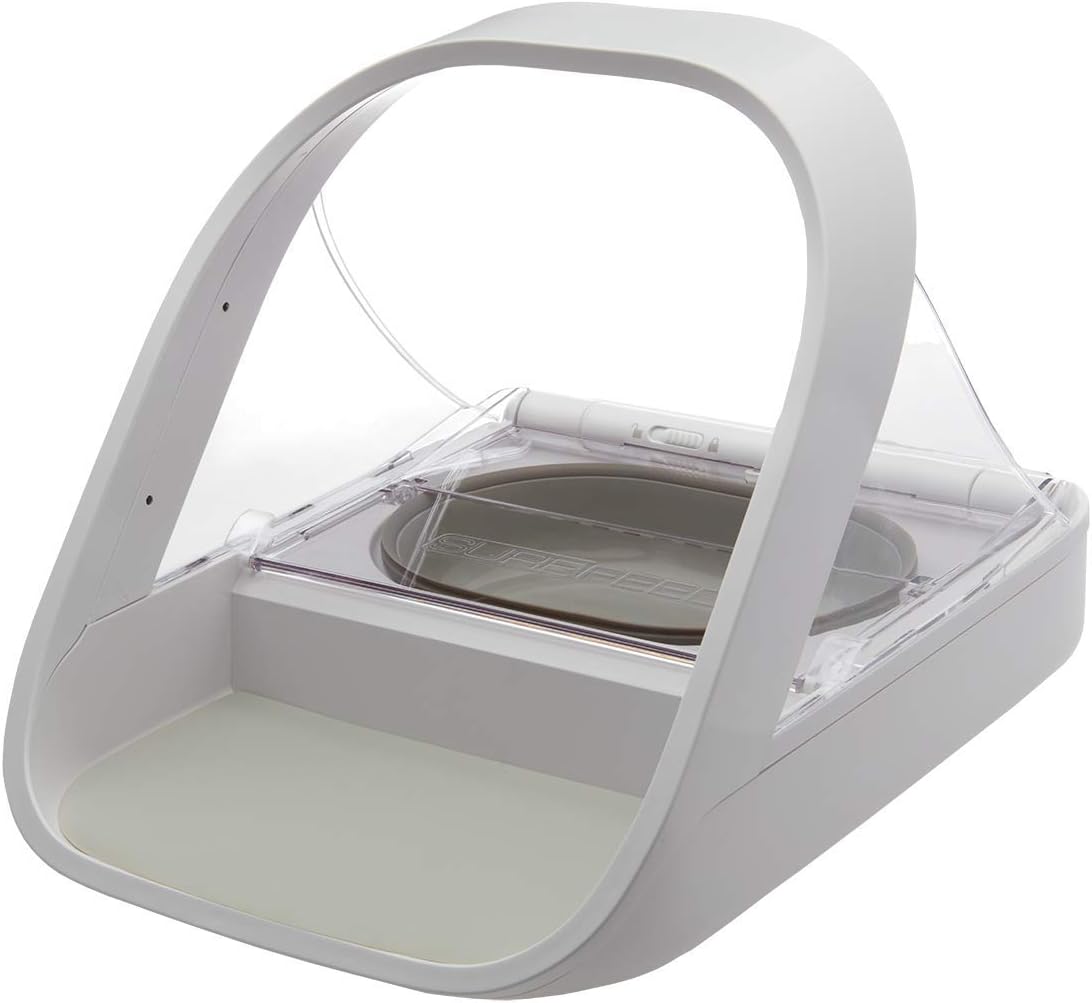
SureFeed uses an electronic reader built into the feeder to identify an authorized cat. If your cat has a compatible identification microchip, you can register it with the feeder and use that chip to control access.
When the registered cat approaches the bowl and enters the reading area, the lid opens. When the cat moves away, the lid closes again to help prevent other animals from eating the food.
The major advantage is that your cat doesn’t have to wear anything. There’s no special tag to lose, collar to remove, or accessory to replace.
If your cat doesn’t have a compatible implanted chip, SureFeed also supports SureFlap RFID collar tags, with one included in the standard package.
SureFeed can store up to 32 registered identities. However, registering several cats to one feeder doesn’t give them separate food portions. It simply allows those animals to access the same bowl.
PETLIBRO requires its own RFID collar tag
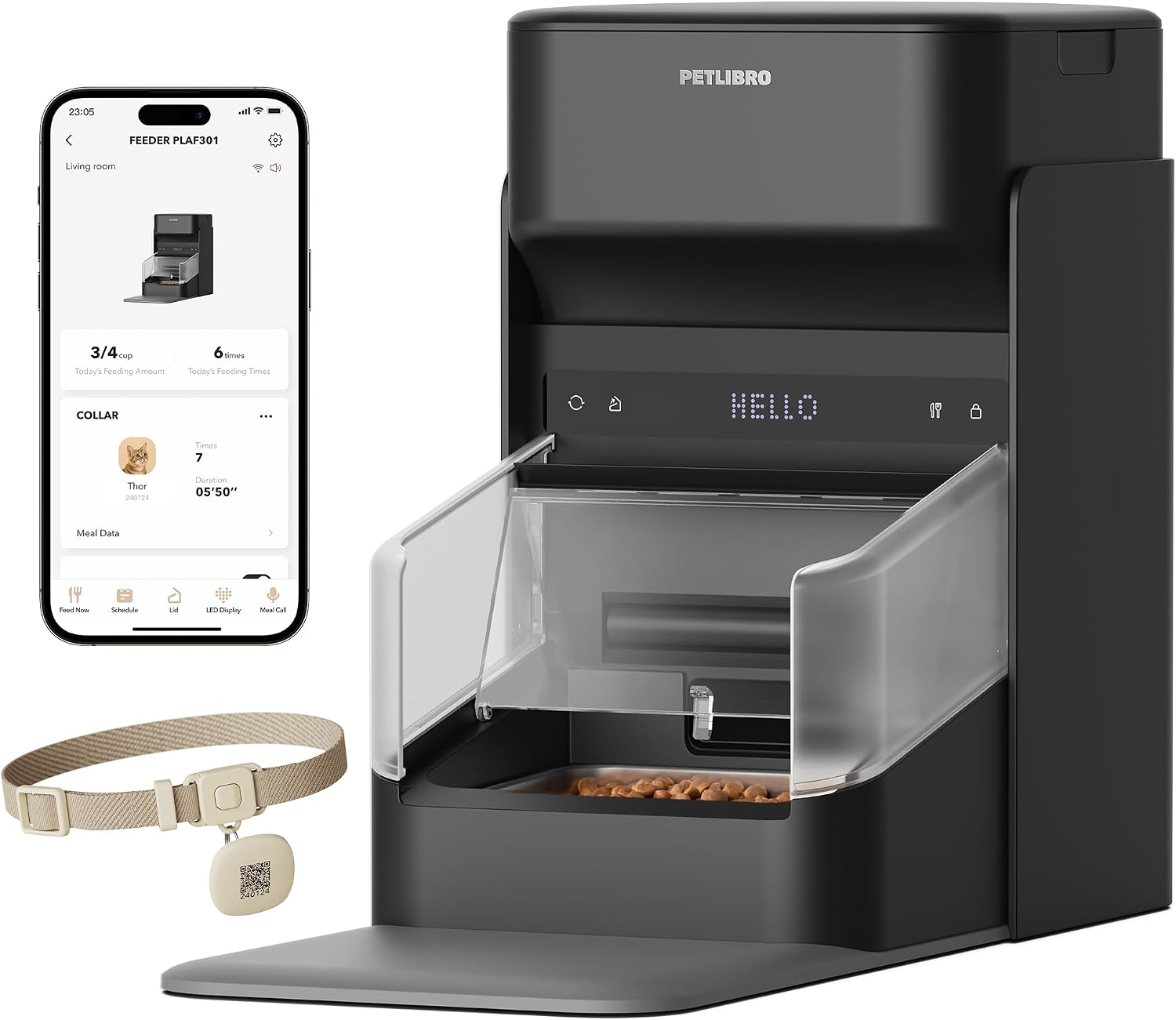
PETLIBRO takes a different approach. Instead of reading an implanted microchip, the One RFID feeder recognizes a dedicated tag attached to your cat’s collar.
The feeder uses a reader positioned near the food bowl to check for that specific tag. When the correct cat approaches, the lid can unlock and allow access.
PETLIBRO One RFID cannot read your cat’s implanted identification microchip. It also doesn’t accept arbitrary RFID tags from other brands.
That means your cat must wear the supplied compatible tag to use the restricted-access functionality. Each One RFID feeder can be paired with one active tag.
This is an important limitation for cats that dislike collars, frequently remove them, or lose them while exploring.
Winner: SureFeed for identification convenience. Being able to use an existing implanted microchip eliminates an extra accessory and makes the feeding routine simpler.
2. Preventing food stealing: Which feeder works better?
Both feeders can help reduce food stealing, but neither should be considered a guaranteed solution for every multi-cat household.
The biggest factor is how your cats approach the feeder and whether another pet tries to push into the feeding area.
SureFeed: Better for protecting an existing meal
SureFeed works well for cats that prefer to eat gradually throughout the day. You place food in the bowl, and the feeder keeps it covered until an authorized cat approaches.
For example, imagine you have two cats. One needs prescription food, while the other eats regular dry food. With SureFeed, you can assign the cat on the special diet its own feeder, reducing the chance that the other cat will help itself to that food.
This also makes SureFeed useful for slow eaters. Your cat doesn’t have to finish the entire serving immediately just because another animal is waiting nearby.
However, there is a limitation. A determined cat may attempt to approach from the side or slip its head into the bowl while the authorized cat is eating. The feeder’s lid and identification system reduce unauthorized access, but they cannot completely prevent this behavior.
PETLIBRO: Better for controlling when food becomes available
PETLIBRO offers an advantage for cats that tend to overeat whenever food is available.
Rather than filling a bowl with an entire day’s worth of food, you can schedule smaller dry-food portions throughout the day. The feeder dispenses those portions, and the RFID system restricts access to the cat wearing the correct tag.
That combination can be helpful if you want more structured meals without manually feeding your cat multiple times a day.
However, PETLIBRO’s collar-based recognition creates another consideration. If your cat loses its collar, the feeder cannot identify it properly. Other animals may also attempt to access the bowl while the lid is open.
And although PETLIBRO can record feeding activity, those records should not be treated as a definitive measurement of how much food your cat swallowed.
Winner: SureFeed for protecting prepared meals; PETLIBRO for controlling scheduled dry-food access.
If your main concern is a particularly aggressive food thief, observe both cats during initial use. Additional barriers, separate feeding areas, or supervised feeding may still be necessary.
Feature | ||
|---|---|---|
| | |
Feeder type | Protected food bowl | Automatic dry-food dispenser |
Identification | Implanted microchip or SureFlap tag | Dedicated PETLIBRO RFID collar tag |
Food compatibility | Wet and dry | Dry kibble only |
Food capacity | 400 ml bowl | 3 L hopper |
Scheduled feeding | No | Up to 10 meals daily |
Smartphone app | No, standard model | Yes |
Power | 4 C batteries | Power adapter, 3 D backup batteries |
Number of recognized pets | Up to 32 | One paired tag per feeder |
Best use | Preventing access to prepared meals | Scheduled, individualized dry meals |
Price | | |
3. Wet food vs dry food: SureFeed has a clear advantage
One of the easiest ways to decide between these feeders is to consider what your cat eats.
SureFeed supports wet and dry food
SureFeed accommodates wet food, dry kibble, or a combination of both. It includes a standard bowl and a divided bowl, with approximately 400 ml of total capacity.
The covered design helps limit exposure to air and insects between meals, which may be useful if your cat eats slowly.
This makes SureFeed particularly appealing for cats eating wet prescription diets or mixed wet-and-dry meals.
However, the lid does not refrigerate food. The FDA recommends promptly refrigerating or discarding leftover canned or pouched pet food, so a covered feeder should not be treated as a way to leave wet food out indefinitely.
PETLIBRO is designed for dry food only
PETLIBRO One RFID has a three-liter hopper, equivalent to approximately 13 cups of dry food. Its manufacturer specifies compatible kibble sizes of 2–15 mm.
That capacity is useful for automatic feeding because you can load multiple meals without opening the hopper every time.
But PETLIBRO cannot dispense wet food through its dry-food dispensing mechanism. If your cat eats primarily canned food, this model is not an appropriate replacement for a wet-food feeder.
Winner: SureFeed for food versatility. PETLIBRO wins for storing and dispensing scheduled dry-food portions.
4. Automatic feeding and portion control: PETLIBRO wins
This is where the two feeders become fundamentally different products.
SureFeed controls access to food, but the standard model doesn’t automatically dispense meals. You are responsible for measuring portions, filling the bowl, and replacing the food.
If you normally feed your cat twice a day and simply want to prevent food stealing, that may be all you need.
PETLIBRO goes further by allowing you to program up to 10 meals or snacks daily through its smartphone app.
For instance, you might prefer to divide a cat’s daily dry-food allowance into smaller servings rather than provide a large bowl in the morning.
With PETLIBRO, the feeder can dispense those scheduled portions without someone needing to be home for each meal.
This can be particularly convenient for owners with changing work schedules or cats accustomed to frequent small meals.
There are limitations, though. Dispensed portions may not be exact to the gram, and the amount dispensed isn’t necessarily the amount consumed. It is worth measuring several actual portions with a kitchen scale during setup.
Also, neither automatic feeding nor RFID identification replaces veterinary guidance on calorie requirements or prescription diets.
Winner: PETLIBRO One RFID. It’s the only one of these two standard models that automatically dispenses scheduled meals.
5. App features and daily convenience
PETLIBRO offers Wi-Fi connectivity and app-based controls, while the standard SureFeed Microchip Pet Feeder works without a phone or home network.
With PETLIBRO, you can configure feeding schedules and view feeding records through the PETLIBRO app. This makes it easier to review when the feeder operated or when a tagged cat interacted with it.
For a busy owner, having this information available on a phone is convenient. It can also help you notice changes worth investigating, such as a cat approaching its feeding station less frequently.
However, feeding activity isn’t a substitute for monitoring appetite, body weight, or health. A cat may approach the feeder without eating its full portion.
PETLIBRO’s app and connectivity requirements also introduce more potential complications during setup. The manufacturer specifies compatibility with 2.4 GHz and 5 GHz Wi-Fi.
SureFeed takes a simpler approach. You register your cat, fill the bowl, and let the feeder recognize the microchip automatically. There is no app account, Wi-Fi connection, or software scheduling to manage.
One important clarification: Sure Petcare also sells the SureFeed Microchip Pet Feeder Connect, a separate model with app-connected monitoring and weighing features. Those features should not be confused with the standard SureFeed model covered here.
Winner: PETLIBRO for smart features. SureFeed is preferable if you want a simpler feeder with fewer connected components.
6. Cleaning and maintenance
Both feeders require regular cleaning, but the maintenance tasks differ.
Cleaning the SureFeed
SureFeed uses a removable bowl and lid system. You can remove the food bowl for cleaning and wipe down the surrounding feeder surfaces.
Because you manually prepare each serving, there is no large food hopper or dispensing mechanism to empty and maintain.
However, you’ll need to keep the reading area clean and check that the lid opens and closes properly.
Wet food can also leave residue on the bowl and lid, making frequent cleaning especially important.
Cleaning the PETLIBRO
PETLIBRO includes a stainless steel food bowl, which is a useful feature for routine washing.
The food hopper, dispensing mechanism, desiccant, and RFID reader area introduce additional maintenance considerations. You’ll need to check for food residue, ensure kibble is dispensing properly, and replace consumables according to the manufacturer’s instructions.
Keeping the electronics and RFID components dry is important.
For either feeder, the FDA advises washing and drying pet-food bowls after each use.
Winner: SureFeed for mechanical simplicity. PETLIBRO’s removable bowl is convenient, but an automatic dispensing system naturally requires more components to inspect.
7. Reliability, batteries, and power outages
SureFeed operates on four C-cell batteries. Sure Petcare estimates approximately six months of typical battery life, although actual performance depends on usage. A low-battery indicator alerts you when the batteries need replacing.
Because the standard feeder doesn’t rely on Wi-Fi, loss of internet connectivity doesn’t interfere with its normal operation.
PETLIBRO primarily operates using its power adapter, with three D-cell batteries providing backup power.
That backup is useful in a power outage, but owners should not assume that all internet-connected functions remain available during battery-only operation. Confirm the operating behavior for your exact hardware and firmware version.
A cat that depends on a specialized diet shouldn’t have its access to food depend entirely on an unfamiliar automated device without a backup feeding plan.
Winner: SureFeed for simpler standalone operation. PETLIBRO offers power backup, but its scheduling and connected functionality add more variables.
8. Price and long-term value: Is PETLIBRO or SureFeed worth it?
These are both premium feeders compared with an ordinary food bowl, so the purchase should solve a problem that matters in your household.
PETLIBRO’s US product page has advertised the One RFID feeder at approximately $150, although promotions, packages, and retailer prices vary. SureFeed prices also vary by retailer and whether you’re purchasing the standard or Connect model.
Rather than compare temporary discounts, consider the total cost of ownership.
Cost factor | SureFeed | PETLIBRO One RFID |
|---|---|---|
Initial purchase | Premium feeder | Premium smart feeder |
Power expense | Replacement C batteries | Electricity and backup batteries |
Food accessories | Optional replacement bowls and mats | Desiccant and compatible replacement accessories |
Collar tag | Optional with compatible implanted chip | Required |
Wi-Fi | Not required | Required for connected setup and features |
Multiple cats on separate diets | May need separate units | One tagged cat per feeder |
One additional consideration is PETLIBRO’s optional Care subscriptions, which provide broader wellness-management services and device coverage. Check the current terms and distinguish those optional services from the feeder’s standard app functions before purchasing.
What about buying multiple feeders?
Suppose you have three cats, each requiring separate portions or different food.
One feeder generally won’t solve all three feeding problems.
With SureFeed, you may need an individual feeding station for each cat whose food must be protected. Although one SureFeed can recognize multiple cats, all authorized animals access the same bowl.
With PETLIBRO, each One RFID feeder pairs with one tag, so independently managing three cats’ dry-food schedules ordinarily means purchasing three units.
This is where the total price can climb quickly.
If only one cat requires a special diet, you may not need to buy separate restricted-access feeders for every pet. You could protect that cat’s food and manage the others through ordinary or supervised feeding arrangements, provided the overall setup actually prevents unwanted access.
9. Which feeder should you buy for your cats?
The better choice depends on your household more than the number of features advertised.
Your situation | Our pick | Why |
|---|---|---|
One cat steals another cat’s wet food | SureFeed | Supports wet food and microchip access |
A cat needs scheduled small dry-food meals | PETLIBRO | Dispenses portions automatically |
Your cat refuses to wear a collar | SureFeed | Can recognize an implanted microchip |
You want app-based feeding records | PETLIBRO | Provides connected feeding features |
Your cat eats prescription wet food | SureFeed | Protects prepared wet-food portions |
You want no Wi-Fi dependency | SureFeed | Works as a standalone feeder |
You work irregular hours | PETLIBRO | Automates dry-food schedules |
Choose SureFeed Microchip Pet Feeder if…
You have cats with different food requirements, your cat is a slow eater, or you want to reduce access to prescription food.
It’s especially attractive if your cat already has a compatible implanted microchip and you don’t want to add a collar.
The downside is that you still have to provide the meals yourself. It doesn’t solve the problem of needing someone to dispense food throughout the day.
Choose PETLIBRO One RFID if…
Your cat eats dry kibble, you want to schedule several portions per day, and the cat is comfortable wearing a collar with the supplied RFID tag.
It is particularly useful when your problem involves both controlling food access and automating feeding times.
The main disadvantages are reliance on the proprietary tag, greater setup complexity, and the inability to dispense wet food.
10. Frequently asked questions
Can PETLIBRO One RFID read my cat’s microchip?
No. PETLIBRO One RFID model PLAF301 recognizes its own dedicated RFID collar tag. It cannot read implanted identification microchips or unrelated collar tags. If you specifically want to use your cat’s implanted microchip, SureFeed is the better option.
Does SureFeed automatically dispense food?
No. The standard SureFeed Microchip Pet Feeder protects a bowl you fill manually. It doesn’t store a supply of food for scheduled dispensing. PETLIBRO One RFID offers automatic dry-food dispensing.
Can another cat steal food from a SureFeed?
Yes, it remains possible in some circumstances. Although SureFeed restricts access based on registered identification, another cat may attempt to reach the food while an authorized cat is eating. Observe your pets, use appropriate feeder placement, and consider separate feeding areas if needed.
Can PETLIBRO feed two cats with one RFID feeder?
PETLIBRO One RFID can pair with only one dedicated tag at a time. If two cats require independent access and separate portions, you’ll generally need separate feeders or another feeding arrangement.
Is SureFeed suitable for prescription cat food?
Yes. SureFeed can help protect prepared prescription food from other pets, provided the food is compatible with the bowl and stored safely. It doesn’t ensure that a cat eats its prescribed amount, so you still need to monitor intake and follow your veterinarian’s instructions.
Does PETLIBRO One RFID require a subscription?
PETLIBRO advertises app-controlled feeding functions and also offers optional Care subscriptions for additional wellness-related services. Check the current features available without a subscription before buying; don’t assume the optional Care service is mandatory for basic scheduled feeding.
Which feeder is better for overweight cats?
Both can be useful depending on the feeding problem. SureFeed helps protect a measured portion from other animals, while PETLIBRO automates scheduled dry-food portions. Neither guarantees weight loss. Proper calorie targets, accurate food measurements, and veterinary guidance remain important.
Final verdict: SureFeed or PETLIBRO One RFID?
For most households primarily trying to stop one cat from stealing another cat’s prepared food, we recommend the SureFeed Microchip Pet Feeder.
Its ability to recognize implanted microchips, support wet and dry diets, and operate without Wi-Fi makes it a straightforward solution for separating meals. It’s particularly useful for slow eaters and cats on special diets.
However, the PETLIBRO One RFID is the stronger option if your goal goes beyond food protection.
Its automatic dispensing, programmable schedule, and feeding records make it a more complete dry-food management system for owners who want to automate daily feeding.
Ultimately, the decision comes down to two questions: Do you need to protect food that is already in the bowl, or do you need a machine that dispenses food at specific times?
If food protection is the priority, choose SureFeed. If automated dry-food portions are the priority, PETLIBRO is likely the better fit.
Sources and product documentation
This comparison is based on publicly available manufacturer specifications and supporting documentation. It is a research-based product comparison, not a claim of personal hands-on testing.